How do you make sure a CDFI loan portfolio is healthy? Merely reviewing balances and repayment status won't give you the full picture.
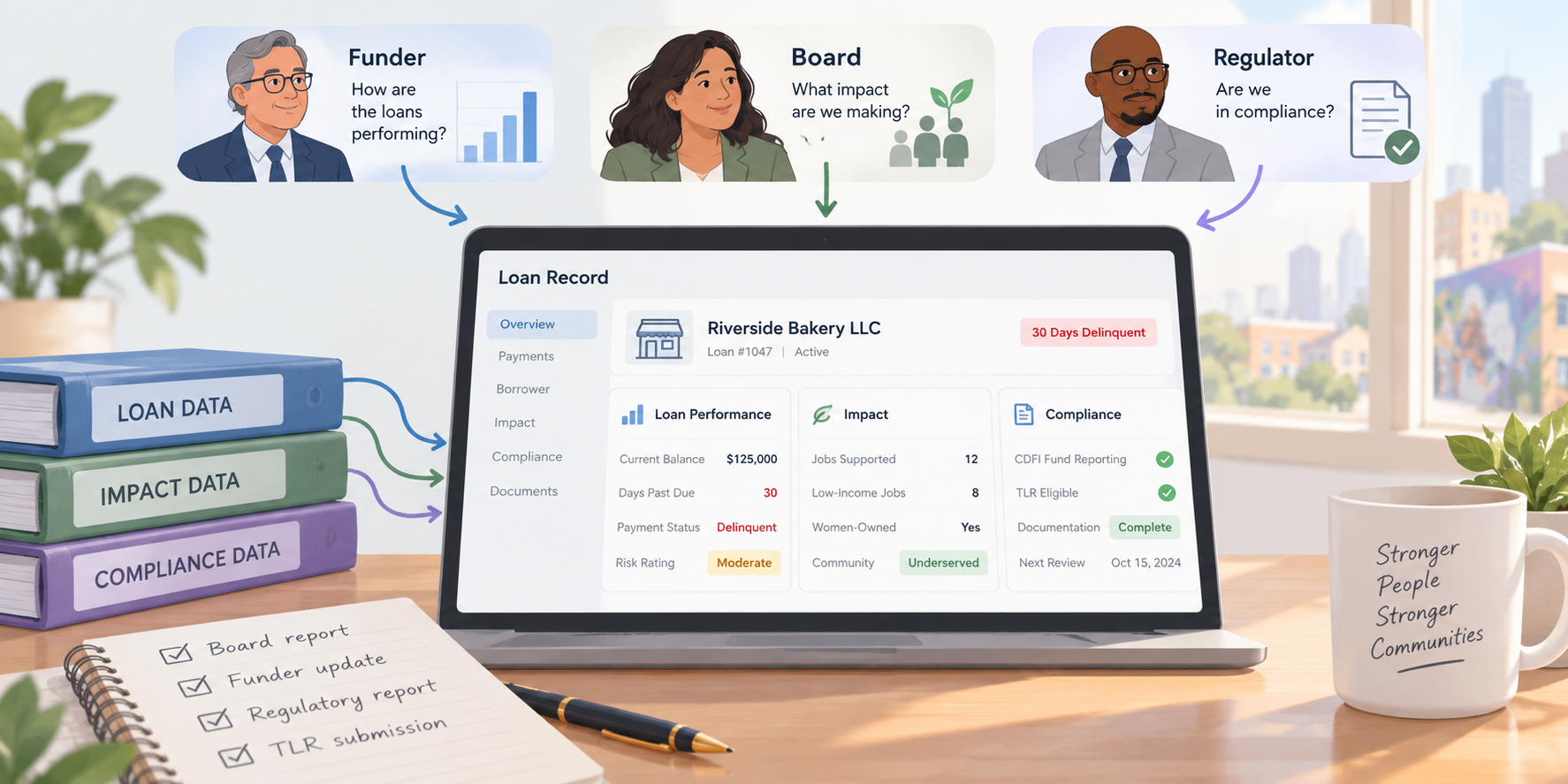
A portfolio manager needs to explain financial performance to the board, show community impact to a funder, and maintain accurate transaction records for any regulatory and program requirements. Each audience has a different way of looking at the portfolio, but all questions lead back to the same borrowers and loans.
As such, monitoring a CDFI portfolio involves much more than simply tracking loan performance. CDFIs require ongoing visibility into three aspects of their portfolios, which are credit performance, mission impact, and compliance.
When these aspects live in separate systems, spreadsheets, and documents, it becomes complicated to answer even straightforward portfolio questions. If you connect them at the loan level, you get a clearer picture of your portfolio health and create a solid foundation for decision-making and reporting.
What Does CDFI Lending Portfolio Monitoring Need to Cover?
Traditional portfolio management focuses heavily on financial performance. For CDFIs, financial health remains critical, but it represents only one dimension of ongoing monitoring.
These perspectives can lead to different questions about the same event.
How Should CDFIs Track Delinquencies When Credit and Mission Goals Disagree?
For CDFI delinquency tracking, servicing metrics such as days past due, missed payments, outstanding principal, aging buckets, risk ratings, modifications, and charge-offs are used.
But identifying delinquency is only the beginning of the workflow.
A portfolio manager needs to know:
- Were there any communication with the borrower?
- Was technical assistance provided?
- Did the parties agree upon new terms regarding the repayment schedule?
- Is the business still operating?
- Would changing the loan terms increase the likelihood of repayment?
This context helps organizations maintain a credit discipline while considering their mission.
For instance, if a loan moves into the 30-day delinquency bucket, it can trigger collection activity and risk review. It also creates tasks for borrower outreach or technical assistance. Any restructuring, payment promise, modification, or other intervention remains connected to the servicing history.
That connection is especially important if management ever wants to understand why delinquencies have risen, and what was done to try to improve the situation for both individual borrowers and portfolios.
Why Does CDFI Technology Often Disconnect Impact Reporting From Loan Data?
Impact information typically exists independently of your core servicing process.
Jobs created or retained can be captured through borrower surveys. Community impact might reside in spreadsheets. The demographic characteristics or program data may be found in CRM fields. Supporting documentation may reside in PDFs, email attachments, or grant-management systems.
At the same time, balances, payments, delinquency status, and modifications are stored and maintained somewhere else.
The challenge arises when someone asks a combined question:
How are the loans funded through this program performing, and what impact have they produced?
Answering this question is not so simple. You need to match borrower names, loan numbers, addresses, program identifiers, servicing info, and impact spreadsheets prior to starting any meaningful analysis.
Technology fragmentation continues to be an important issue throughout this industry. In Federal Reserve CDFI Survey data revised in March 2026, 69% of respondents said technology challenges hindered their ability to meet demands, while 71% reported they lacked adequate staff to manage services. Among responding CDFI banks and credit unions, 72% identified integration with current systems to be one of the biggest problems when it comes to technology.
For CDFI impact reporting, connecting impact data to the loan reduces the reconciliation effort required to comprehend both financial and mission performance.
What Changes When Performance, Impact, and Compliance Reporting Share the Same Loan Record?
A connected loan record creates a common point from which different teams can understand the portfolio.
- The servicing team can view balances, payment history, delinquency, fees, modifications, and collection activity.
- Mission teams can associate the loan with jobs, housing units, technical assistance, businesses supported, or other outcomes.
- Compliance teams can maintain applicable geography, Target Market information, funding sources, eligibility, and supporting documentation.
This does not mean every stakeholder needs the same dashboard. It means their dashboards can rely on the same underlying information.
As loans become delinquent, portfolio managers can be looking at what characteristics (product type, geographic, funding source, etc.) these delinquent loans have in common. Leadership would then look at how the portfolios are performing against the program's goals. Funders receive information about capital deployment, performance, and impact without requiring teams to assemble a new dataset for every request.
This becomes even more critical as CDFIs plan for growth. Federal Reserve survey data showed that 95% of participating CDFIs wanted to grow their customer base over the next five years, while 87% wanted to increase the level of financing they offer.
With the increase in number of borrowers, loans, programs, and reporting relationships, manual reconciliation becomes harder to sustain. That pressure compounds for teams already managing multiple CDFI loan programs with separate rules and funding sources.
How Does Continuous CDFI Portfolio Monitoring Make Reporting Easier?
Addressing data quality only near the filing deadline makes the reporting complicated. Teams then have to find information, match records, correct addresses, identify any missing values, review exceptions, and reconcile conflicting data from multiple disconnected systems. It's the same scramble many teams face ahead of CDFI TLR reporting.
Continuous portfolio monitoring shifts the sequence. One can capture and review required information during origination, servicing, borrower outreach, modification, and impact measurement. When a piece of missing information is identified, it becomes an operational problem that needs to be solved immediately rather than several months later.
The CDFI Fund continues to administer programs that involve large amounts of CDFI capital. Nearly $3 billion in bonds has been guaranteed by CDFI Bond Guarantee Program to date, providing CDFIs with long-term capital for eligible community and economic development projects.
For an individual CDFI, the practical lesson is straightforward. The strongest reporting process starts when portfolio data is created and maintained, and not when someone begins compiling the report.
This way, reporting becomes an extension of how daily lending activities are conducted rather than being a periodic exercise of recreating all data.
How does cmLending Support CDFI Portfolio Monitoring?
Cloud Maven, Inc's cmLending loan origination and servicing capabilities natively on Salesforce enables lenders to manage borrowers, loan, servicing, documents, payments, and workflow information within a single platform. For community lenders, our CDFI loan management solution shows how cmLending supports the way CDFIs manage and monitor their portfolios.
For ongoing portfolio management, cmLending supports payment tracking, delinquency management, collections, borrower requests, loan modifications, document management, and portfolio reporting. The lending workflows can be integrated with third-party services for payments, credit, identity verification, banking information, documents, and other lending data.
The teams can build portfolio views that are much deeper than just outstanding balance and delinquency status. They can monitor servicing performance while maintaining the additional information required to understand borrower support, funding programs, community outcomes, and reporting obligations.
Better CDFI Portfolio Monitoring Creates a More Complete View of Portfolio Health
A CDFI portfolio cannot be fully evaluated based on its repayment performance.
A portfolio can demonstrate high repayment rates while providing limited insight into the outcomes of its mission. Another may be able to produce positive impact on community while borrower stress levels may begin to rise. A third may exhibit well financial and programmatic performance, but then it requires weeks of reconciliation as compliance information is spread across multiple systems.
Effective CDFI portfolio monitoring connects all these three dimensions together.
When performance, impact, and compliance information remain connected to the same borrowers and loans, CDFIs can identify potential risks sooner, comprehend their borrower needs, demonstrate mission outcomes with greater confidence, and respond to boards, funders, and compliance requirements using consistent data.
The broader goal is to have a portfolio that can answer the organization's most important questions throughout the year, regardless of who is asking.