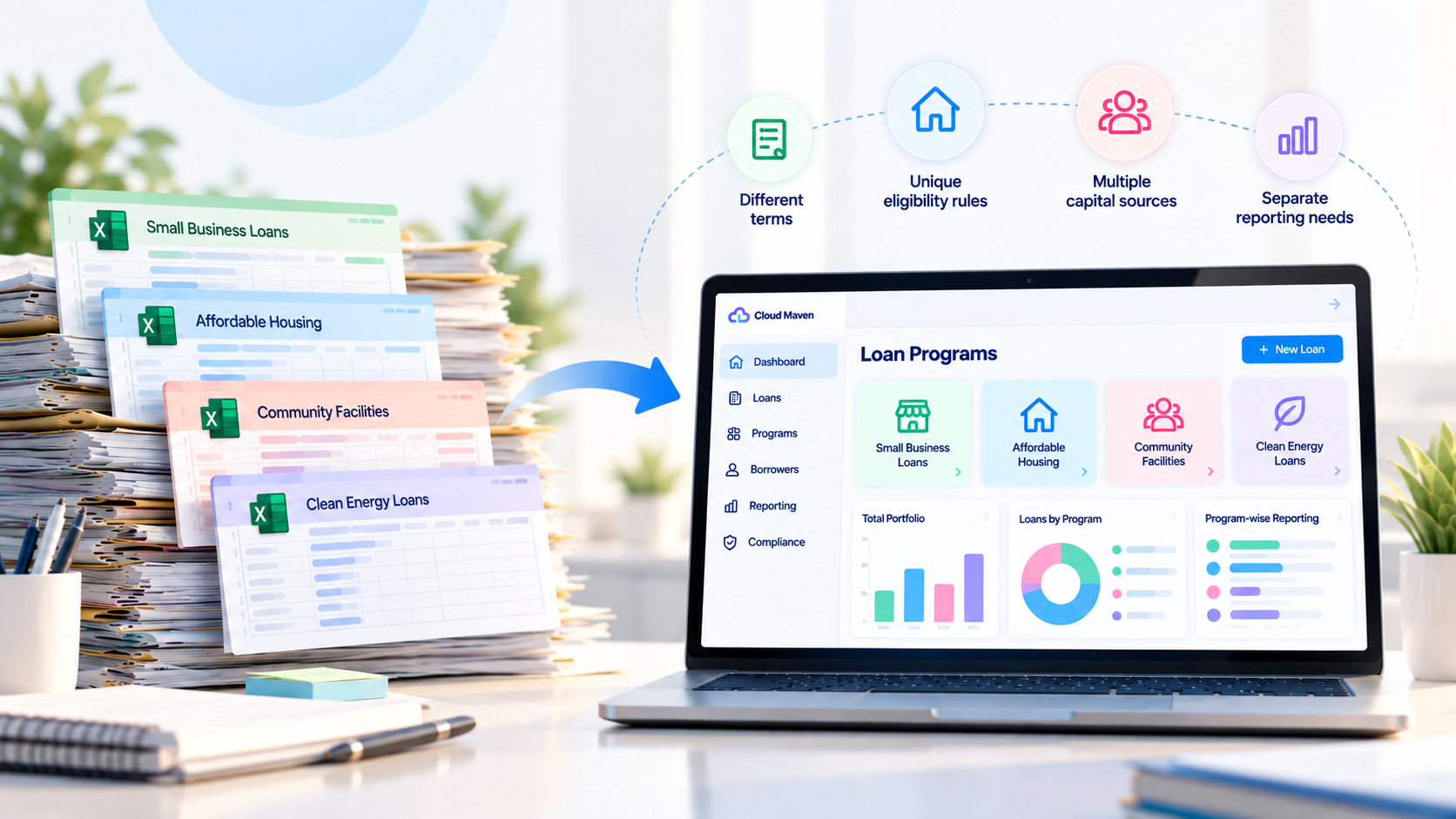
Managing one CDFI loan program through spreadsheets may be workable. The program manager knows the eligibility rules, the team understands the underwriting requirements, and everyone is generally aware of which funding source supports which loans.
But you add a second, third, or fourth program, and this operating model gets complicated.
A small business lending program may have some geographic limitations that are not applicable to a microloan program. An affordable housing initiative might use a separate source of capital with specific restrictions. A special-purpose fund may require different borrower documentation, approval criteria, impact metrics, and reporting.
For CDFIs managing multiple loan programs, the question is: How do you ensure every loan follows the rules of the right program without relying on spreadsheets and employee memory?
What Managing Multiple CDFI Loan Programs Looks Like Day to Day
Consider a situation where a CDFI is running four lending programs at once.
Each program works perfectly by itself. The problem arises when staff work on all four or more programs at the same time.
A program manager may need to evaluate one worksheet to verify borrower eligibility, another to determine available fund, a shared document for underwriting requirements, and an email thread to confirm an exception granted several months ago.
It is also possible for the same borrower to qualify for more than one program. This creates potential confusion as to which program should fund the loan, and what rules apply?
The scope and number of available community development capital emphasizes this dilemma. For calendar year 2026, the CDFI Fund announced $5 billion in New Markets Tax Credit allocation authority for investment in low-income and distressed communities.
As new funding options become available, CDFI loan programs require a reliable method to connect borrowers, loan offerings, program rules and capital providers.
Where Do Your CDFI Program Rules Live Today?
Before looking for spreadsheet alternatives for CDFIs, you need to determine where your organization’s operating rules actually live.
Many times, you’ll find them in multiple locations such as:
- Spreadsheets maintained by various departments
- Grant agreements and program documents
- Underwriting guidelines
- Shared drives and folders
- Email conversations that document exceptions
- Notes maintained by individual employees
- Knowledge accumulated by experienced program managers
The last category represents one of the largest risk factors.
When the Program Rules Live in Someone's Head
Many lending teams eventually develop some version of this instruction:
"Ask John. He can tell you about the program and how it works."
John probably has an understanding of one program's specific property types, another program’s lower maximum loan amount, and third program’s required documentation for approval. He may even be able to recall which capital source supports a particular borrower.
The process continues to work as long as John is available. If he is on vacation, overloaded with responsibilities, or leaves the organization, it becomes chaotic.
How? The problem with finding a replacement is much bigger than finding a spreadsheet. Another employee must understand the logic behind the information in it.
Three Failure Points in Multi-Program CDFI Lending
The risks become most visible in three areas: eligibility, underwriting, funding allocation, and reporting.
Underwriting Rules for Small Business Loans Can Be Applied Inconsistently Across Programs
Different CDFI programs can have different requirements involving geography, borrower characteristics, business type, loan purpose, income, project type, or loan amount.
Staff need to manually review a borrowers' application against multiple spreadsheets and program documents, which results in varying interpretations.
If two employees are reviewing the same borrower, they can reach different conclusions as they work from varied versions of the criteria or remember an exception differently.
The issue compounds with an increase in number of programs. For every new program introduced into this environment, your employee has one more set of conditions to evaluate and apply.
A Valid Loan Can Still Be Assigned to the Wrong Capital Source
Never treat borrower eligibility and capital eligibility as the same thing.
A borrower can meet CDFI's lending criteria whereas a particular source of capital can impose additional restrictions on geography, loan purpose, borrower type, deployment period, etc.
That distinction becomes important when CDFIs participate in specialized funding programs.
For example, the CDFI Fund opened the FY2026 Small Dollar Loan Program with up to $9 million in awards to specifically support Loan Loss Reserves and Technical Assistance for eligible small-dollar lending programs. The program also defines small-dollar loans as loans that cannot exceed $2,500.
At the same time, the FY2026 Bank Enterprise Award Program opened with up to $40 million available in awards to eligible FDIC-insured institutions that increase qualifying investments in CDFIs or lending and investment activity in distressed communities.
Reporting Cannot Be Cleanly Separated by Program
CDFI Reporting becomes even more complicated when you treat program identity like an additional column in your spreadsheet that is applied post-loan origination.
An operations manager may need to answer questions such as:
- How much has each program originated?
- Which capital source funded each loan?
- How much capital remains available?
- Which borrowers were served through a particular program?
- What is the delinquency rate for each program?
- Which impact metrics need to be reported to each funder?
To accurately answer these questions, team members are required to first resolve discrepancies in the underlying data regarding how the loans have been accounted for across worksheets.
What Changes When Each Program's Rules Live in the System?
An alternative to creating multiple additional spreadsheets is to "configure" programs. The general trade-offs between software and manual tracking are covered in our comparison of loan management platforms and manual processes but for a multi-program CDFI, the bigger change is where the rules themselves live
One program can have its own eligibility criteria, loan limits, pricing rules, documentation requirements, underwriting conditions, funding sources, and reporting fields. A second program could use an entirely different configuration within the same lending environment.
When a borrower applies, the system assists in determining which set of program rules apply and maintains this association throughout the loan cycle. This also changes the role of the program manager.
Instead of recalling every rule, the manager maintains the rule framework. Rather than asking staff members to remember which checklist applies, the apt requirements get automatically triggered based on the selected program.
This allows for consistent tracking of CDFI loans without requiring all of the lending programs to operate with one process.
What Portfolio-Wide Visibility Looks Like Across CDFI Loan Programs
The benefit of maintaining all programs and their rules in a single place is that the management can see lending activity throughout the entire organization while retaining program level details.
The organization can transition from asking "Which spreadsheet contains that information?" to filtering a common dataset by program, funding source, geography, borrower type, loan status, or reporting period.
This is the operational value of managing CDFI loan programs centrally.
How Cloud Maven, Inc’s cmLending Supports Multi-Program CDFI Operations
For CDFIs ready to move their processes in one place, our cmLending offers a Salesforce-native lending platform to manage all aspects of the loan lifecycle within one ecosystem.
CDFIs can use cmLending to configure different lending programs, capture borrower and application information, specify eligibility and underwriting rules, manage documentation, generate loan offers and amortization schedules, track funding and servicing activity, and report across lending operations.
Since program specific requirements are maintained as the loan data is stored centrally, this allows teams to decrease their reliance on separate worksheets and individual employee knowledge.
The objective is not to run every CDFI program the same way. It is to provide each program with an established operating structure while giving management a consistent view across the organization. For teams starting to compare options, our guide on what to look for when choosing a lending platform walks through the questions to ask before committing.
Managing More Programs Should Not Mean Managing More Versions of the Truth
A spreadsheet can hold tens of thousands of rows. So, capacity is never the problem.
The difficulty with several CDFI loan programs is that the staff has to remember which rules apply to borrowers, the type of capital to be used to support loans, and the types of reporting requirements for each individual program.
Those rules are supposed to remain an integral part of the lending decision-making process. But as these programs continue to grow, there is no reason why they need to be spread across spreadsheets, documents, emails or even the memory of employees.
A centralized lending platform, like cmLending, provides a way for CDFIs with multiple programs to create a long-term sustainable business model, specifically by having program specific rules where differences matter and overall portfolio visibility where management needs the complete picture.