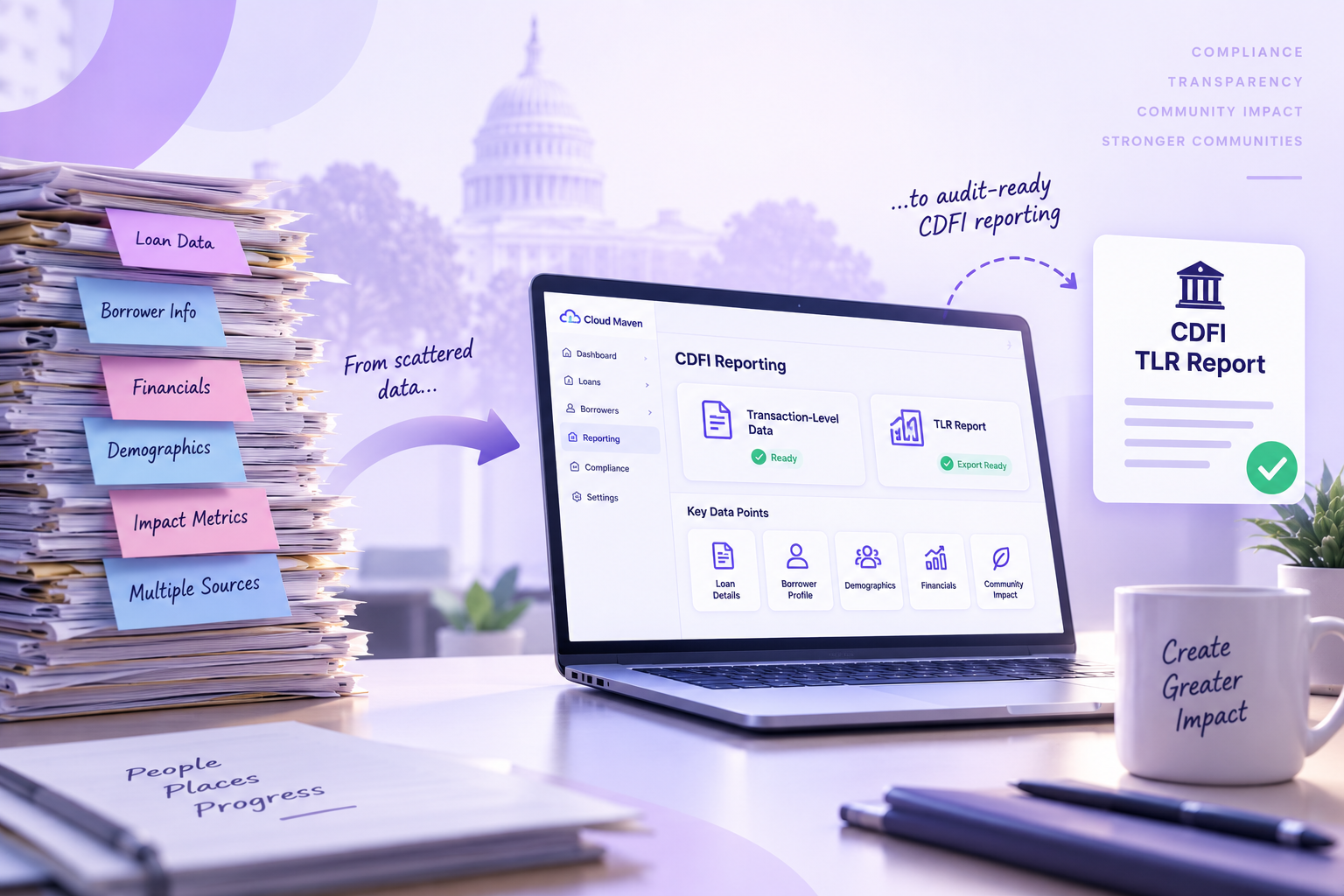
For many Community Development Financial Institutions (CDFIs), the hardest part of Transaction Level Report (TLR) preparation is not when the reporting deadline approaches. It starts much sooner, when a loan is originated and the information required for reporting is recorded in various formats, entered inconsistently, stored as paper documents, or never documented at all.
By the time your compliance or operations team begins preparing the report, they likely have to go back through a full year of lending activity. Staff search loan files looking for borrower info, comparing that to what is in the servicing records, making sure addresses match, reviewing original loan terms, and determining which values accurately represent each transaction. This is where loan management software for CDFIs can make a difference. When reporting data is captured in a structured form as lending activity occurs, preparing the report becomes much more manageable.
That’s why to improve CDFI TLR reporting you need to look at the entire process and start with where all the data begins.
The CDFI Fund defines the full-length Transaction Level Report as collecting transaction-level information on every new loan and investment made during the applicable reporting period. Such info includes loan rates and terms, underwriting criteria, project costs and characteristics, geography, and borrower characteristics.
When these details are captured in a structured form as lending activity occurs, preparing the report becomes much more manageable.
What CDFI TLR Reporting Requires From Your Loans
CDFI transaction-level reporting can involve considerably more details than a simple list of loans originated in the year. Based on the institution and reporting obligations, information needs to come from different areas of the lending process.
Also, the reporting structure can have more than one dataset. As per the CDFI Fund's guidance, a TLR submission may include up to 4 additional reports or objects, such as the Consumer Loan Report, TLR Address Report, Loan Purchase Report, and Financial Services Report, which are based on the institution's activities.
This is why it is important for CDFIs to confirm their current requirements through AMIS and the latest CDFI Fund guidance versus using a static internal checklist. This May, the Fund has already published updated Full-Length and Abbreviated TLR guidance, Target Market Calculator guidance, and a new TLR Data Point Collection Guide.
Why CDFI Transaction-Level Reporting Becomes a Month-Long Project
At most CDFIs, the data the TLR asks for exists somewhere. The problem is where. Let’s take a look at what happens to one loan during its lifecycle.
The borrower enters information through an online application. Credit information arrives via integration. Underwriting details get documented in a credit memo. Final loan terms are recorded in the loan origination system. Documents are stored separately. After closing, servicing becomes the primary source for current balances and payment activity.
Twelve months later, the compliance team needs one coherent transaction record.
Several common issues arise at that point:
- Required information was never collected as structured data. A borrower characteristic might be in an uploaded application but not in a searchable field.
- Multiple systems contain different values. A borrower might have moved after origination, so the application and servicing system now show different addresses.
- Important information exists only in documents. The loan terms, project information or other details about borrowers need to be manually extracted from PDFs.
- Historical values have altered. Servicing data represents the loan today, while transaction-level reporting might require data which relates to the original transaction.
Each of these issues causes staff to manually investigate prior to being able to prepare the report. Your staff spends time repairing the underlying data before they can begin reporting it.
How Loan Management Supports CDFI Compliance Reporting Data During Origination
For a smooth CDFI compliance reporting process, start by decoding where every reporting value should originate.
- During borrower intake, required information should be collected via controlled fields rather than free-form notes.
- During underwriting, loan characteristics, approved terms and relevant decision information should be stored against the application.
- At closing, the system should preserve final transaction values related to the originated loan.
- When the loan moves into servicing, the original transaction data should remain tied to the loan while servicing information keeps changing throughout the loan lifecycle.
This creates a trail of where the data came from. Instead of wondering where a value came from, your compliance staff can follow it back to the application, borrower, loan or related transaction record.
How CDFIs Can Build Reporting Controls Into the Lending Workflow
Capturing data is just one aspect of the process. CDFIs can also avoid reporting issues by validating information when possible to do so.
A lending workflow can:
- Ask for reporting-critical information to be collected before a transaction reaches a defined stage
- Apply conditional requirements based on loan, borrower or product type
- Validate address and data formats prior to closing
- Use controlled values where standardized categories are a must
- Preserve original transaction data in event of change in servicing values
- Identify any missing data before commencement of the annual reporting cycle
- Maintain relationships between borrowers, applications, loans, collateral and transactions.
This way, CDFI TLR reporting moves from being a year-end activity that involves cleaning up data to an ongoing data-quality process.
For institutions with limited operating resources, it’s especially important. As per CDFI Fund statistical snapshot, among 565 Certified CDFIs having total assets under $50 million, the Fund noted that nearly half of CDFIs in the dataset were considered small.
So, for smaller organizations, repeatedly assigning staff just to reconstruct information from hundreds or thousands of records puts a significant burden on compliance and operations teams.
What Happens When Reporting Data Is Trapped in PDFs?
Not every reporting-relevant value arrives through a structured application.
Some borrowers upload financial statements, scanned versions and supporting documents. Older transactions might have information only inside the PDFs, whereas some documents might be poorly scanned or inconsistently formatted.
An extraction layer can help identify selected information inside these documents and convert it into structured fields.
How Structured Data Changes CDFI Transaction-Level Reporting
When transaction information is consistently captured throughout the lending process, the reporting team's workload changes significantly.
Surely, automation eliminates the need for manual work to look for, reconstruct and reconcile the underlying information. You still need to review the data or comply with CDFI Fund requirements.
The reporting environment continues to evolve. In January 2025, the CDFI Fund scheduled 11 monthly TLR webinars from February through December in order to help institutions address the TLR submission process.
This year, in June 2026, the Fund has launched a redesigned TLR submission and certification experience in AMIS, adding capabilities such as historical Target Market Calculator results, bulk deletion of uncertified TLR data, improved geocoding information and additional certification controls.
A Practical CDFI TLR Readiness Check
Before the next reporting cycle, compliance and operations teams should ask:
- Can every important reporting value be linked back to a defined source field?
- After you begin loan servicing, can all original transaction amounts be preserved?
- Has anyone validated both the borrower and geographic records prior to closing?
- Can teams identify missing reporting data without opening individual loan files?
- Are applications, borrowers, loans and related transactions connected?
- Can team identity any incomplete or inconsistent records before reporting begins?
If several answers are no, the largest reporting problem may occur well before the TLR is prepared.
How Cloud Maven, Inc Helps CDFIs Prepare Reporting-Ready Data
Cloud Maven, Inc.’s cmLending platform helps CDFIs keep lending information connected within Salesforce from borrower intake through origination and servicing.
Instead of leaving important information scattered across documents, spreadsheets, and disconnected systems, cmLending helps capture and structure data as part of the lending workflow. Borrower and application information can be collected in defined fields, while financial statements and supporting documents remain connected to the appropriate borrower, application, or loan.
Document Insight can extract relevant information from structured and unstructured documents and map selected values into Salesforce fields. This reduces the need to reopen PDFs months later just to locate reporting data.
Financial spreading further organizes financial information used during underwriting into structured data. This helps teams retain the information behind the credit analysis rather than relying only on source documents.
With credit memo, you bring borrower, financial, underwriting and approved loan information together. This way key transaction details and the basis for the lending decision remain associated with the loan.
As the loan progresses, validation controls can also help identify missing, incomplete, or inconsistent information earlier instead of waiting until reporting preparation begins. Original transaction information can remain connected to the loan even as servicing activity changes over time.
Combined with structured application data, validation controls and servicing records, these capabilities give reporting teams a more connected source of information when preparing the applicable TLR dataset.
Our platform does not alter CDFI Fund reporting requirements. The goal is to reduce the operational, manual effort required to find, reconstruct and reconcile the information used to fulfil those requirements.
Make TLR Preparation Part of the Lending Process
Although CDFIs cannot simplify the federal reporting requirements, they can still reduce the manual work required to prepare for it.
When you consistently capture borrower information, original loan terms, underwriting data, addresses and transaction characteristics as they occur during lending process, you become less dependent on retrospective research for your annual CDFI transaction-level reporting.
So, when reporting season begins, instead of rebuilding twelve months of lending activity, your compliance team should focus on reviewing structured information.
If you are still assembling TLR information from spreadsheets, PDFs and disconnected applications, Cloud Maven, Inc can help you identify where reporting data originates and how it can be captured earlier in the lending workflow.
Schedule a free consultation today.