
Process ACH, Card, and eCheck Payments Faster in Salesforce With cmPay
cmPay processes card, ACH, and eCheck payments inside Salesforce and syncs transactions with QuickBooks. Finance teams automate billing schedules, manage refunds, and track revenue in real-time dashboards without leaving the CRM or logging into separate payment gateways.
How cmPay Gives Finance Teams a Single System for Revenue Collection

One System Governing the Entire Revenue Cycle
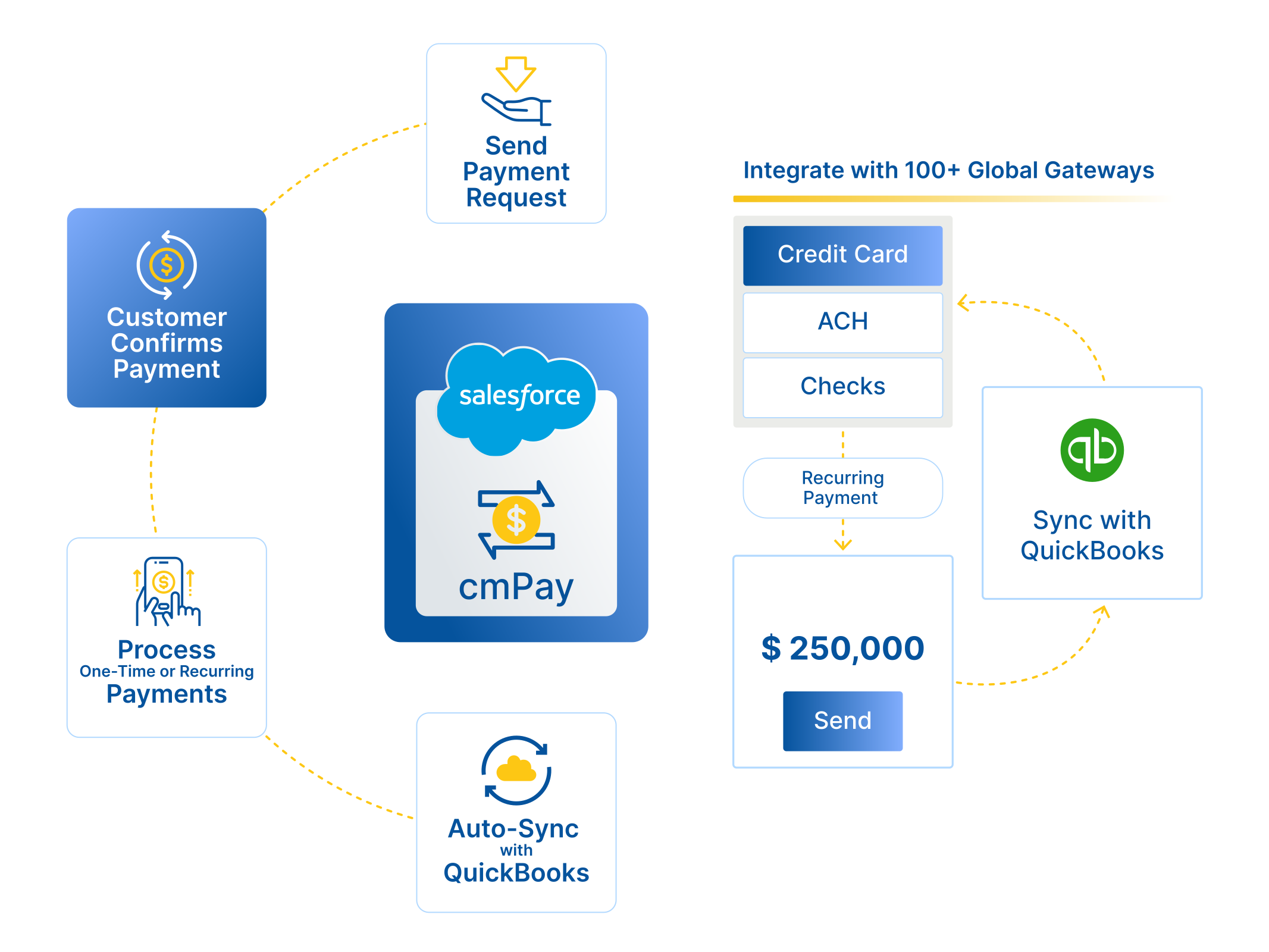
cmPay anchors payment operations inside Salesforce, giving leadership a single, authoritative system for quote-to-cash execution, accountability, and financial clarity across teams. Organizations can manage ACH payments, credit card transactions, recurring billing, refunds, and payment tracking while supporting 100+ payment gateway integrations through one connected platform.

Immediate Revenue Recognition Across the Organization
When payments originate in Salesforce, sales, finance, and operations work from the same real-time financial truth, strengthening forecasting, collections discipline, and customer decision-making. Finance teams gain immediate visibility into successful transactions, failed payments, customer balances, and overdue accounts without relying on disconnected systems.

Trusted Financial Data Built Into Daily Workflows
cmPay ensures payment activity is captured at the source and passed downstream cleanly, reducing revenue leakage, reconciliation errors, and the operational risk created by disconnected systems. Teams can reduce manual payment matching efforts and improve reporting accuracy across billing, accounting, and customer support workflows.
The Two Apps That Power cmPay

A Salesforce-native solution for managing credit cards, debit cards, and ACH payments. Process one-time payments, recurring billing, refunds, voids, and payment links directly from Salesforce while supporting 100+ payment gateway integrations.
Enable real-time, two-way syncing of customers, invoices, and payments with QuickBooks. Automatically keep accounting and CRM records aligned between QuickBooks Online and Salesforce to reduce reconciliation delays and duplicate data entry.
Why Finance and Billing Teams Choose cmPay for Payment Automation

Faster AR Cycles
Automate ACH payment, eCheck, and card collections to reduce sales outstanding. inance teams can trigger payment reminders, scheduled collections, and overdue account follow-ups automatically, helping accelerate cash flow and reduce manual collections work.

Recurring Billing & Subscriptions
Set up ACH transfer and subscription plans with smart retry and flexible billing rules. Teams can automate recurring membership fees, loan repayments, installment plans, or monthly service subscriptions while reducing failed-payment follow-up efforts.

Payment Links
Generate secure, branded payment links directly from Salesforce to collect payments faster. Sales and servicing teams can send payment links through email or SMS for invoices, deposits, renewals, or past-due balances without requiring customers to log into separate payment portals.

Compliance & Security
Provide PCI compliant payments using audit trails, tokenization, and secure processing. cmPay supports secure payment workflows across major gateways such as Stripe, Authorize.net, Fiserv, PayPal, etc. while helping organizations reduce exposure to sensitive card data inside Salesforce.

Reduced Operational Overhead
Replace manual workflows and external vendors with native Salesforce payment integration. Organizations can consolidate payment collection, reporting, reconciliation, customer communication into one platform, reducing duplicate systems and administrative overhead for billing and finance teams.

Real-Time Processing
Obtain immediate Salesforce payment processing status, confirmation, and settlement. Teams can instantly view approved payments, failed transactions, refunds, voids, and settlement updates directly from Salesforce records without waiting for batch syncs.

Frequently Asked Questions
How can I process ACH or eCheck payments directly inside Salesforce?
With Payment Connect, you can accept ACH transfers and eCheck payments right from Salesforce without switching systems. It works by securely validating bank account details, initiating the ACH transaction, and tying the payment back to the relevant Salesforce record.
For teams that rely on recurring billing, membership payments, or invoicing, it eliminates manual entry and cuts processing errors dramatically. The whole flow happens inside Salesforce, which keeps your payment history clean and traceable.
Is your app a PCI-compliant payment solution for Salesforce users?
Yes, Payment Connect is built to support PCI-compliant payments, making it suitable for organizations handling sensitive billing data. Here’s why teams trust it:
- No raw payment data stored in Salesforce
- Tokenization used for repeat charges
- Encrypted transmission for every transaction
- Support for multiple payment gateways, including Stripe, Fiserv, PayPal, Actum, Authorize.net
This means you can run credit card, ACH, and eCheck payments without worrying about compliance burden or adding extra tools to manage cardholder data.
Can I use QuickBooks payments inside Salesforce and sync invoices automatically?
Absolutely. QuickBooks Connect brings two-way syncing between QuickBooks Online and Salesforce, so invoices, payments, and customer details stay aligned. You can receive payments in QuickBooks including credit card and ACH and have the status instantly updated in Salesforce without double entry.
For companies juggling sales, accounting, and operations, it removes the manual handoff that often slows collections down or causes reconciliation mistakes.
Does Payment Connect support Salesforce invoicing and recurring payment automation?
Payment Connect works seamlessly with Salesforce invoicing, allowing you to generate invoices, take payments, and record transactions without outside software. It is especially helpful for subscription or installment-based businesses because you can automate:
- Payment reminders
- Scheduled ACH drafts
- Recurring card charges
- Invoice updates in Salesforce
The result is a smoother billing cycle, fewer late payments, and a more predictable cash flow for your team.
What is the difference between ACH electronic checks and eCheck payments, and does Payment Connect support both?
Many people use the terms interchangeably: ACH electronic checks and eChecks both move money through the ACH network. Payment Connect supports these payments in a single workflow. The key difference is that an eCheck is essentially a digital version of a paper check, while ACH transfer is the underlying payment rail. Our app handles the verification, submission, and tracking for both, giving teams a fast, low-fee alternative to credit card payments inside Salesforce.
Testimonials
Hear What 400+ Organizations Say About Cloud Maven, Inc
"Our company has used a handful of credit checking products before coming across Credit Checker, and this is by far the most efficient solution for us. It is user friendly, quick, and organizes the information better than we could have asked for. Their client support team takes any questions/issues very seriously and will quickly find a solution for you. We are looking forward to working with their team for many years to come!"
Brianna Maestre
Operations Manager, iAdvanceNow
"Instant and efficient patient verification. Eligibility Checker is definitely a gift to the health care domain. It instantly checks the eligibility of a patient. Insurance verification and managing patients has become much easier now. I highly recommend this app."

Vaishali Ghai
Salesforce Consultant, Accenture
"Cloud Maven, Inc is one of the absolute best partners I've ever worked with. They are smart, dedicated, innovative, and their software works at scale with great performance. They know Salesforce and custom development best practices. Very impressive, highly recommend!!!!"

Bill Hahn
Sr. Customer Success Architecture, Salesforce
"Great experience and product, Cloud Maven, Inc was a great partner during the entire process. Their support was attentive and helpful, the install was painless and the product works flawlessly. Thanks again Cloud Maven!"

Mike Patchen
Salesforce.com Consultant
"Cloud Maven, Inc is an outstanding business partner. Their collaborative approach with clients is a real strength. Cloud Maven, Inc and team do a terrific job of understanding business and client requirements and translating them into functional and practical applications. They are expert in Salesforce and Java and are a real asset for our team. They are a pleasure to work with."

Jim Byrne
MD, Intercontinental Exchange
"The team at Cloud Maven, Inc was extremely responsive during implementation of our very tight project timeframe. And they knew what we were talking about. When you’re developing on the Salesforce platform, you need a partner who knows both Salesforce and what you are trying to accomplish."

James Slocum
Chief Information Officer, OneUnited Bank
"I have been working with Cloud Maven and Team since 2018, we implemented their credit applications as well as used their onshore and offshore resources to complement our internal teams. We are very satisfied with the outcome of the projects that we did with them. The credit checker application saved us hundreds of hours of custom code to integrate credit bureaus into Salesforce."

Sabetay Palatchi
President, Constructive Finance
"We’ve recently been able to implement the Credit Checker and this is a great feature. It has cut our credit processing time down by probably 75 percent. Cloud Maven has been extremely professional to work with. They’re quick on their responses, very insightful and have walked us through the process. I highly recommend using them."
Ashley Morin
Underwriting Manager, 7-Eleven
"Our biggest challenge prior to getting credit checker was that we simply didn’t have a program in place to be able to run credit, which is a huge decision factor in our industry. With the credit checker, we were able to put a lot of customizations in place so that we can automatically run credit when certain information is in our system. This takes away a lot of manual labor from our processing team and we’re able to work more efficiently."
Lauren Falsetti
Director, Better Rise Capital
"Great solution for us. We can now do all of our credit checks, keep all our information inside of Salesforce. It was a great experience. We got it customized and built to our needs and the tech support is fantastic. We’re very pleased with Cloud Maven. They were able to build a solution for us and the support is fantastic. They’re very responsive and they find a solution for what you need."

Paul Scheller
IT Director, Burch Oil Co
"The secure email allows us to track every single step of the email process. So we are able to keep track of who’s doing what and what’s being accomplished for ease instead of people having to manually keep track of things. Just knowing that everything is securely and safely being sent as a healthcare organization gives us all a peace of mind."

Sara Hildreth
Development Coordinator, Everyday Miracles
"Prior to lending manager, our challenge was to improve productivity with our submissions and sales team. This product makes the process and submitting applications more streamlined. Our sales productivity has increased and the time it takes to submit has been a lot quicker. Our overall satisfaction with Cloud Maven is a 5/5 especially with the quick response time during implementation from their team."

Steven Nagy
Solutions Consultant, Moby Capital