Commercial loans rarely move directly from lender to borrower. Before the borrower receives money in their bank account, the application move through multiple hands, sat idle for weeks or months in email boxes, and possibly delayed due to outstanding tax returns, etc.
For lenders and brokers, this complete journey is where they win or lose deals. Understanding the whole lifecycle of the lending process and how loan origination software fits into this is what differentiates a scalable lending process from one that fails under higher volumes.
A Commercial Loan Lifecycle Follows Multiple Stages Before Funding
The full "lifecycle" of a commercial loan includes all of the steps required for a lender to be able to approve and fund a financing application. These steps include the initial submission by the borrower, the review of the borrower's creditworthiness, the review of the proposed use of the funds, and finally the actual disbursement of those funds. Each stage builds upon the information gathered during the previous stage.
Because many of these steps were developed with paper-based systems and telephone communication before automation entered the picture, this is also why there remains such inefficiency in the middle portion of the process.
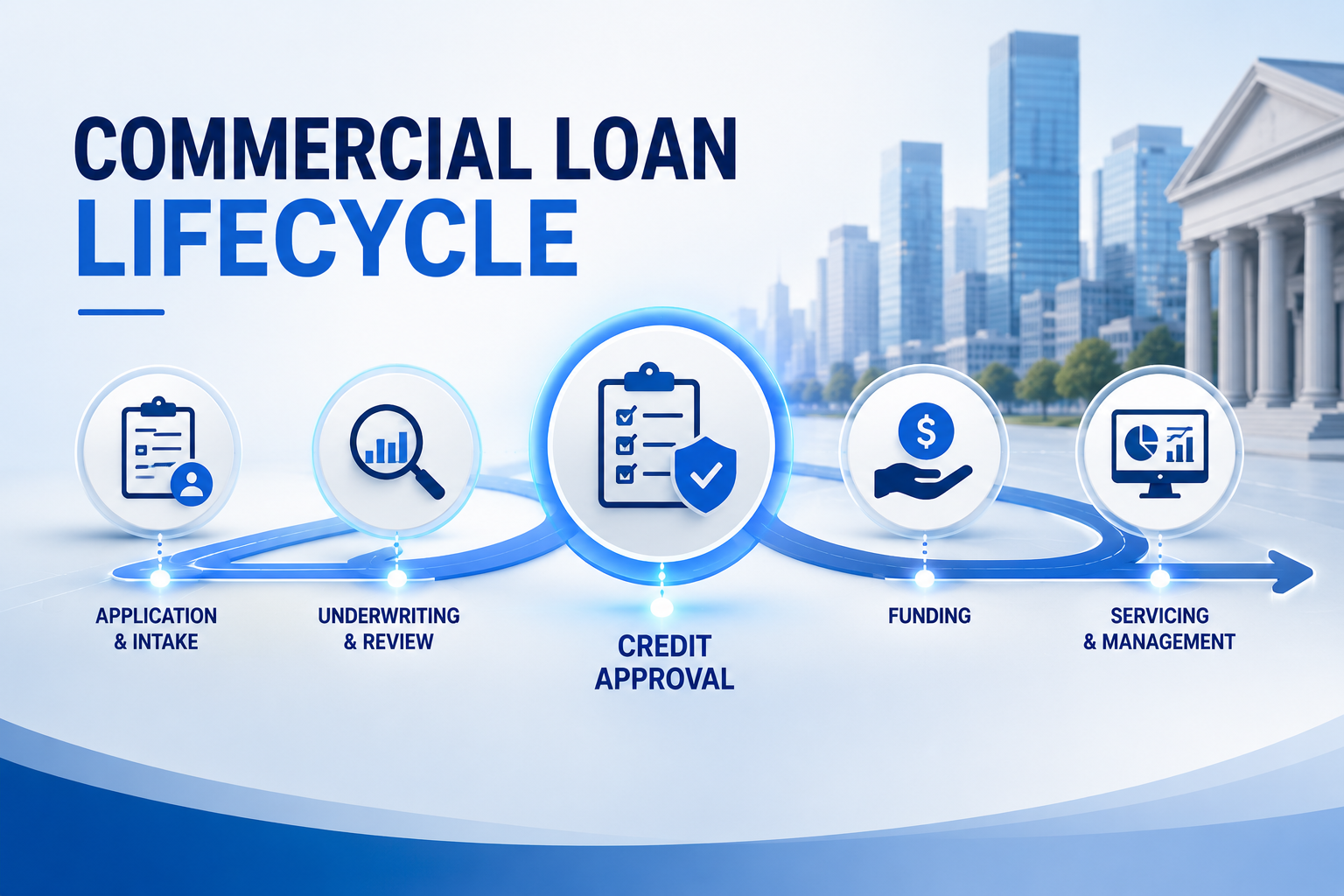
Below is the route most commercial loans follow, along with the spots where things tend to bog down:
Commercial Loan Underwriting and Approval Create the Greatest Delays
It’s worth noting that there are some key steps involved in lending which carry a lot of risk for lenders and eat the most time.
The first step is underwriting. This stage is when an actual decision is made about whether the loan proposal presents a good opportunity for a lender. The underwriter reviews everything the borrower provided, considers all aspects of the collateral, asks for anything else needed, and decides on terms that protect the lender.
When underwriting occurs through spreadsheets and emails, it turns into hours rather than minutes, and even small errors seem to surface at the worst possible times, such as right before funding.
The next step after underwriting is getting final approval for credit. Commercial loans larger than $500K (or whatever the specific limit is) typically require a credit memorandum be prepared and then presented to a group of senior approvers. To manually compile this document takes a great deal of time and effort away from underwriters and sales people creating value.
These two steps are the ones that generally cause delays for the borrowers and if you’re unable to provide a quick answer to these questions, a competitor who can jumps in and steals those opportunities.
Where Loan Origination Software Fits Into the Process
This is the part of the lifecycle where loan origination software does its most visible work. Rather than replacing various stages, the system connects those stages so that when a loan moves from one party to another, it does not start again.
Instead of having a borrower fill out multiple versions of an application for a loan, or worse, having to enter the same information into different programs several times, with a Loan Origination System, the borrower completes one online version of their application. That applicant's information then automatically goes into the underwriting process. Consequently, no personnel have to manually input the applicant's financial information into different processes.
The practical wins show up across the whole chain:
- Digital intake that meets borrowers on any device and cuts down on abandoned applications
- Identity, income, and bank verification processes performed electronically to help reduce the need for manual searches for required documentation
- Automated underwriting and decision processes to quickly evaluate routine loans and direct only difficult loans to a lender for evaluation
- Automated document generation and eSignature to close the gap between approval and a signed agreement
- Real-time pipeline tracking to show which loan is stuck and why
Cloud Maven, Inc's loan origination software ties all these features together within Salesforce. All applicant data and associated loan management decisions are contained in one location as opposed to being scattered throughout five different platforms.
The rapid growth in this space indicates how much lenders want to consolidate. The Commercial Loan Origination Systems market size was approximately $5.3 Billion in 2025 and is expected to grow to nearly $14.5 Billion by 2034.
Commercial Loan Servicing Extends Beyond Loan Funding
Funding can be viewed as crossing the finish line but the lender views funding as merely a transfer of responsibility. Though money has been disbursed, the loan continues to require servicing for the remainder of the loan’s term.
Loan servicing includes all aspects of payment processing, escrow activity, delinquent accounts, and ongoing customer inquiries. Any time loan origination and servicing are processed through different software platforms, that is typically when data begins to fall into gaps and borrowers begin to identify areas of fragmentation within your organization.
An end-to-end model is designed specifically to maintain a connection between origination and servicing. Cloud Maven, Inc's Loan Servicing Model begins immediately after origination and continues until payoff.
Besides, the comprehensive cmLending Suite ties together loan origination, servicing, and syndication so that each loan maintains the complete transactional history from application to payoff without needing to recreate or rebuild the original file.
Choosing Loan Origination Software That Fits Your Lending Model
Not every platform suits every lender. If you choose the wrong one, you may end up spending money that could have been saved by continuing manual process for a little while longer.
There are some factors to consider when thinking about committing to a specific platform:
- If the software is native to the same systems your team currently use, then training is easier and data can be housed in one trusted location.
- If you can easily set up lending rules, forms and workflows for each borrower, broker, SME etc., then you won't need to spend on custom development every time you adjust something.
- What degree of compliance and audit trail functionality does the software provide? In regulated lending, accurate documentation is key to success.
- How much of the verification function is built into the product vs how much has been added-on after the fact?
- Will the chosen software be able to handle increased volumes and/or additional users without requiring a major overhaul a year or two from now?
Lenders are increasingly answering these questions in favor of the cloud. Roughly 68% of financial institutions prefer cloud-based lending platforms, with approximately 57% reporting improved workflow efficiency post-cloud implementation.
Bringing the Lifecycle Together with the Right Commercial Lending Software
A commercial loan touches a lot of people before it ever funds, and every handoff is a chance for the process to either flow or stall out.
By mapping the entire lifecycle of a loan the way we have here can clearly identify when delays occur within this loan origination cycle, and the right commercial lending software helps eliminate delays by creating a workflow that does not require your staff to use an entirely new process.
If you want a clear picture of where the gaps sit in your own pipeline, it is worth walking through your current process with someone who has untangled it before.
Curious where those gaps sit in your own pipeline? The team at Cloud Maven, Inc is happy to walk through your current process and show you what an end-to-end setup on Salesforce would actually look like for your loans.