
The move to digital-first banking operations has fundamentally changed the role of loan management software. Rather than being a "back office" tool for managing the details of the lending process, today's best-in-class loan management software (LMS) enables an organization's core lending function.
As the number of digital lending platforms and real-time decisioning continues to grow, so will the demand for automated loan management systems. According to The Business Research Company, the global loan management software market is expected to increase from $12B in 2025 to $14+ B in 2026. Fintechs have also accelerated their own growth. In 2025 alone, fintech-enabled platforms accounted for 63% of all personal loan originations in the United States.
This growing importance of digital lending continues to create pressure on lenders to select the right loan management software. Although many options may appear to be similar, each performs significantly differently within the real world.
Moreover, the differences in performance usually occur because of a couple of common mistakes that lenders frequently overlook when evaluating a loan management software. By recognizing these issues early on, lenders are able to make a smart and forward-thinking choice.
Let’s look at the most common mistakes lenders make when choosing a loan management software.
Mistake #1: Focusing Only on Upfront Cost Instead of Total Cost of Ownership
Initial price comparisons are common among lenders when selecting a loan management software. But the issue arises when those price comparisons end at the licensing fees.
The total price of software develops over time and looks quite different than what was initially represented. Some examples of overlooked costs are:
- Costs of implementation, integration, and customizing configurations.
- Time spent on training staff and adjusting their workflow processes.
- Continuing support costs, system updates and maintenance costs.
Making a decision based upon long term value rather than initial purchase price is essential in reducing operational risks, particularly for systems central to lending activities.
Mistake #2: Not Clearly Defining Internal Workflows Before Selecting Loan Management Software
Comparing software products becomes difficult when there are no documented business processes to reference against. Thereby, it gets challenging to determine if selected software meets your business needs.
Loan management processes rarely occur in linear fashion. Many processes involved in managing loans include:
- Intake and verification of loan applications.
- Credit assessment and underwriting.
- Approvals and exception handling layers.
- Tracking repayment and collections.
Without mapping these processes prior to evaluating software, teams typically develop assumptions during demonstrations. This is where mismatches occur.
Ultimately, you likely find yourself using a system that appears adequate for most tasks; however, it has been modified through ad-hoc adjustments to the software application itself. These modifications can introduce inefficiencies and inconsistencies in your daily operations.
Documented business processes provide clear criteria to evaluate potential software solutions objectively and minimize the number of trade-offs.
Mistake #3: Ignoring Integration Capabilities
A loan management software rarely operates in isolation. It needs to work along with other systems such as CRMs, payment gateways, credit bureaus, accounting tools, and analytics platforms.
Careless consideration of integration requirements results in immediate issues:
- Data is scattered so there’s no single source of truth.
- Teams duplicate efforts across systems.
- Reports are fractured.
- Decision-making is slowed because complete information is unavailable.
More often than not, these problems do not present themselves until after the software is installed.
Modern lending ecosystems rely heavily on APIs and real-time data exchange. Robust integration capabilities improve both operational performance and reliability of data across the entire organization.
Mistake #4: Choosing a Loan Management Software That Lacks Flexibility or Customization
Lending organizations evolve rapidly. They continue to offer new loan products, update lending policy, and respond to changing market conditions. If a lender selects a rigid loan management system that cannot accommodate the evolving business model, it becomes a major limitation in company’s growth.
Typical limitations include:
- Configuring new loan products becomes difficult.
- Business rules governing loan approval or servicing are rigid.
- Vendors must make minor changes to the system.
- External third-party tools must be used to supplement missing functionality.
On the flip side, excessive customization can lead to unnecessary complexity that is difficult to maintain. A good rule of thumb is to select a flexible system that supports configuration without requiring extensive custom development.
Flexibility is not about providing an unlimited amount of options for customization. It means that an organization should be able to modify its loan management system as needed to support its growing business without hindering its operations.
Mistake #5: Overlooking Compliance and Regulatory Requirements
Compliance is at the heart of lending but often considered after-thought during software selection. Failure to meet regulatory requirements places undue burdens on lenders.
Internal teams are frequently forced to perform manual checks that increase the likelihood of oversight failures. They struggle to produce consistent reports and face challenges during audit trails due to lack of documentation and traceability. Teams experience delays in response to regulatory changes that require immediate action.
Often times, these challenges arise during audits or periods of regulatory change, therefore increasing the cost associated with resolving these issues exponentially.
Selecting a system with built-in compliance features reduces organizational risk while ensuring consistency of process without placing further burdens on employees.
Mistake #6: Poor User Experience and Lack of Training
Regardless of how sophisticated a loan management software is, it cannot achieve its full potential if it is difficult to use. Some lenders place great emphasis on evaluating a loan management software's feature set, while neglecting the ease of use.
This results in lower adoption rates, inconsistent usage, and decreased productivity. Common issues that arise include:
- Confusing interfaces: Users have difficulty navigating dashboards or completing simple tasks.
- Longer learning curves: Employees require more time to learn and become productive.
- More errors: Difficult-to-understand workflow creates errors in data input and processing.
- Resistance to change: Teams begin to revert to manual processes or older systems.
Structured training is also important. If there isn't a good on-boarding process for employees, a well-designed software can still be underutilized. They need to know not only how to utilize the software but how it supports them in their job functions.
A loan management software that has been designed for ease-of-use along with a structured onboarding program results in better adoption and long-term efficiency.
Mistake #7: Choosing Software That Can’t Scale With Your Business
Lenders often purchase a loan management software based solely upon their present-day requirements without considering how those needs change in the near or distant future. While the software works perfectly fine today, limitations develop as the lender expands its operations, introduces new products, or begins operating within other geographic regions.
If an LMS does not scale appropriately, it may cause numerous long-term issues including:
- Higher volume capacity limits: As the lender's portfolio size increases, performance decreases.
- Product limitations: Limitation in expanding products or modifying terms as the lender adds new types of loans.
- Regional constraints: Difficulty managing regional or international operations with varying regulatory guidelines.
- System modifications: The lender is forced to either replace or significantly alter the software as it grows.
Ultimately, these limitations may result in significant investments of resources either in replacing the existing software or creating major operational interruptions.
Therefore, selecting scalable solutions from the onset allows you to meet growing demands without requiring continuous investment or interruption.
Mistake #8: Not Evaluating Vendor Support and Partnership Quality
Choosing a loan management software is not a one-time event; it is a long-term relationship with the vendor. Most lenders are extremely focused on the "features" and price of system but ignore the quality of the vendor's support and their ability to develop a lasting partnership.
When you implement the system and for some time afterward, having prompt and experienced assistance can greatly impact how well your company operates. A lack of good vendor support can create problems such as:
- Slow response times: Lenders may experience delays from vendors who are slow to respond to critical problems that impede day-to-day activities.
- Limited onboarding support: Vendors often have inadequate training or documentation available to lenders during the implementation process. This leaves many lenders without adequate direction.
- Lack of proactive communication: Some vendors fail to communicate new releases, fixes, etc. to their customers until these are already released.
- Poor domain understanding: Vendors' support staffs often don't understand the workflows involved in lending and therefore provide little meaningful assistance.
A report by Zendesk states that 73% of all consumers switch to a competitor after multiple poor experiences.
Mistake #9. Vendor Lock-in without an Exit strategy
Some Lenders are so eager to get going that they don't think through what would happen if they needed to leave the vendor. They ultimately end up with vendor lock-in which makes it difficult, expensive, and operationally challenging to move away from a loan management software.
Vendor Lock-in typically presents itself much later, such as once vendors have built long-term relationships with lenders, or when lenders want to try something different or expect more than the original agreement.
At this point, flexibility is extremely limited. Potential risks of vendor lock-in include:
Data restrictions: The lender has difficulty exporting their data in a format that they can easily use.
Switching costs: There are high costs associated with the transition from one system to another; both time and money are at stake.
Limited control: The lender depends entirely on the vendor for updates, changes, or integrations.
Contractual limitations: The lender enters into long-term contracts with provisions that limit their options for leaving the vendor.
By assessing the data portability, open architecture, and contract flexibility before purchasing software, lenders can feel assured that they will retain control over their own technological decisions.
How to Choose the Right Loan Management Software
Picking the best loan management system is more about matching technology with your business strategy rather than making direct comparisons of the features listed.
The most effective system should be able to help you accomplish all of what you do currently, from origination to servicing and syndication, and allow you to continue growing as a company without creating obstacles.
A practical way to evaluate your options is to focus on a few essential criteria:
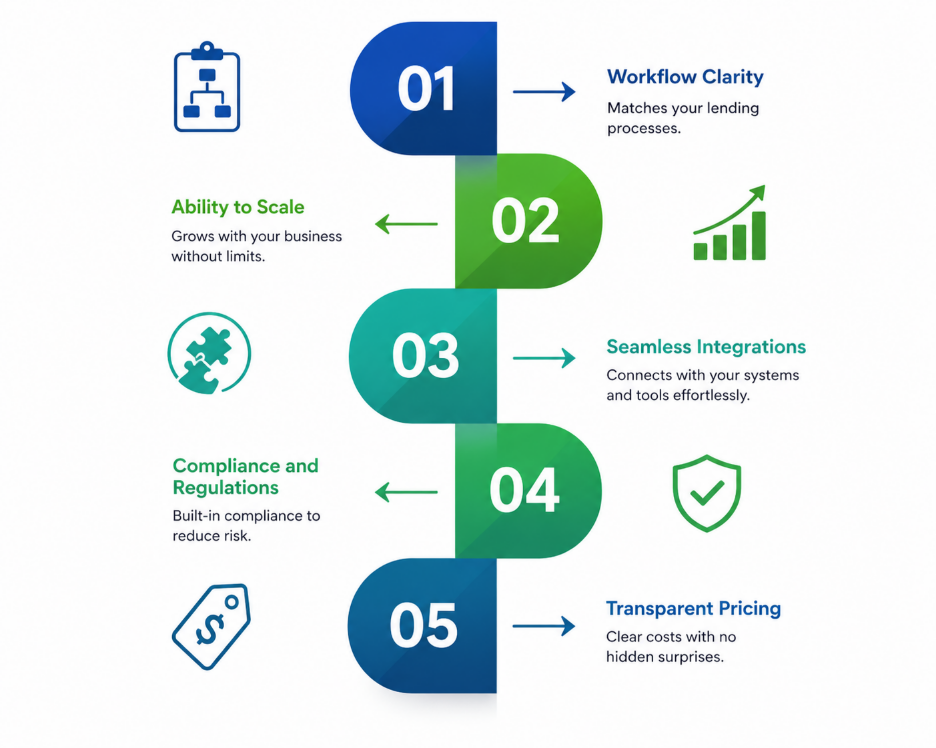
Workflow Clarity
The software needs to match up with the processes you have in place (origination, servicing, collection) and not require significant operational changes.
Scalability
The software's architecture needs to support your ability to increase volume of loans, add new products or expand into different markets without compromising its speed.
Integration
The software needs to provide seamless integration with CRMs, payment systems, credit bureaus, and analytics tools so that there is a unified ecosystem.
Compliance
Auditing trails, reports and regulatory support need to be built directly into the software to minimize your exposure to risk and make compliance easier.
Pricing Transparency
There must be transparency in your costs associated with implementing, maintaining, and upgrading the software so that you don't get caught off guard with unexpected expenses.
cmLending by Cloud Maven, Inc is designed around these principles. Built on Salesforce, it offers an integrated approach to loan origination, servicing, collections, and syndication, allowing you to manage the entire lifecycle without switching systems.
The platform provides both the flexibility to customize workflows and automation, enabling lenders to automate their processes and view their operations in real time.
Wrapping Up
Selecting a loan management software is a choice that impacts the efficiency at which your lending business operates, how well it mitigates risk, and how quickly it grows.
While the mistakes discussed throughout this article are common, they are also avoidable if addressed properly during the selection process. It's time to go past just comparing surface level characteristics and determine whether the software matches how you actually work.
The right system can greatly improve operational efficiencies, increase accuracy, and promote compliance since inception. Solutions such as cmLending show what this looks like when a single platform provides flexibility, automation, and usability, while enabling companies to prepare for future growth.
At its core, the goal is not just to handle loans better but to create a foundation for the business to function with clarity, consistency and confidence over time.