
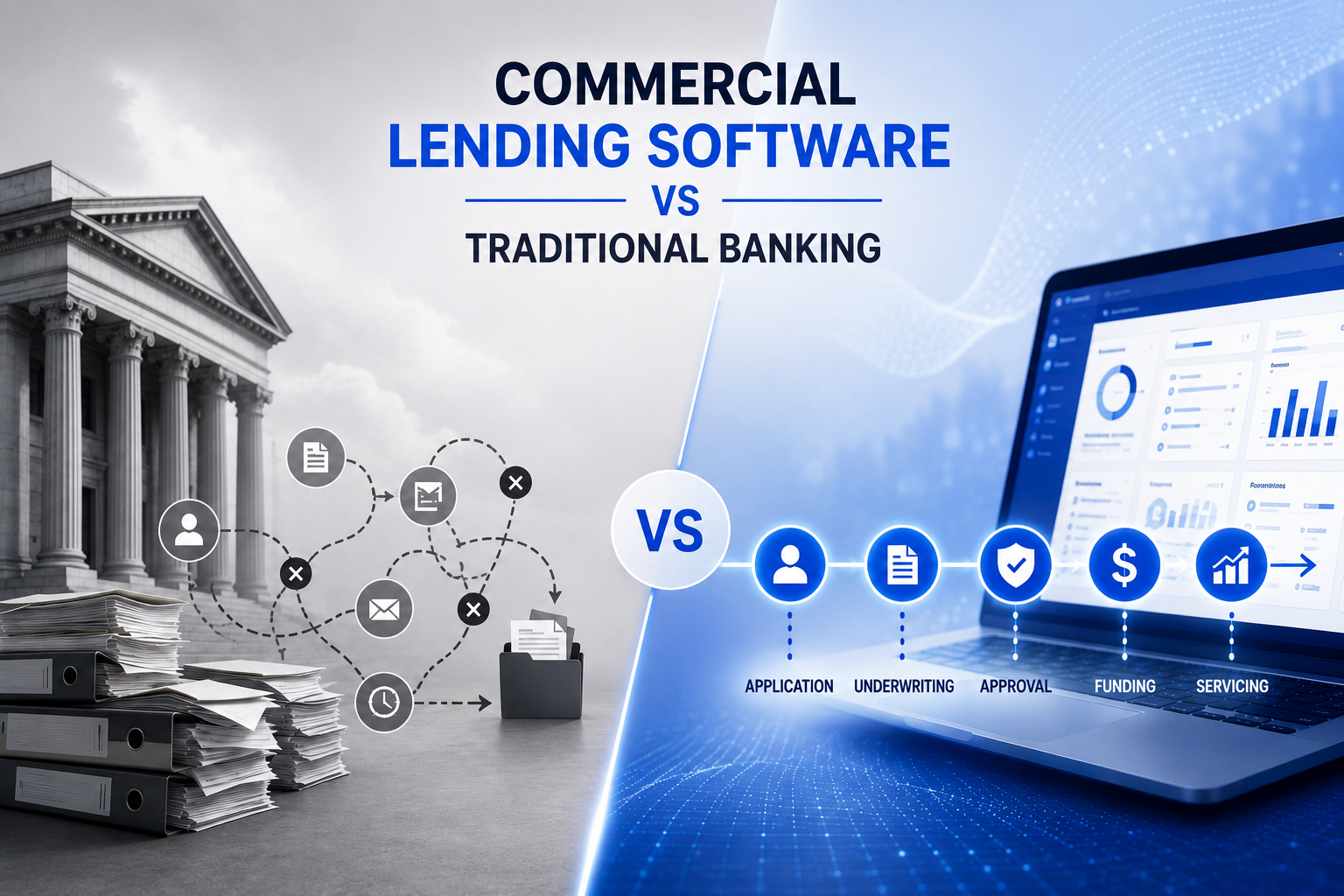
Lenders rarely lose business deals solely due to price issues. More often, they lose out due to long response times, tedious labor required for reprocessing, and system's inability to process at the speed borrowers now expect.
Commercial lending is still performed by most traditional banking systems. However, economic pressures are increasing the likelihood that future commercial lending will be handled by dedicated commercial lending software.
This blog compares the two loan management methods commercial lending software vs. banking systems, in terms of cost, processing time, regulatory compliance and scalability, so lending teams can see exactly where the gap shows up and what it costs them.
What Commercial Lending Software Does That Traditional Banking Systems Cannot
The traditional bank is designed to store your account information or complete financial transaction, but it has never been designed to be a tool for managing the entire lifecycle of a commercial loan. This means loan origination, underwriting, servicing and reporting are all done by different types of tools. Spreadsheets and e-mail have filled in as "the connector" between those disparate tools. Each time you pass an item from one person or application to another increases the opportunity for an error.
The term "lending lifecycle" refers to the process of lending money from a lender (bank) to a borrower. Commercial lending platforms provide a singular point of entry for lenders to manage their loans throughout the lending lifecycle. They can collect borrower information and documents, run credit and ID checks on borrowers, make underwriting decisions, fund loans, service existing loans, and monitor portfolios without having to switch back-and-forth between multiple applications.
Lenders benefit from a reduced number of manual touch points associated with each loan and a single source of truth for all files being managed.
Commercial Lending Software and Traditional Banking Systems Differ Across Key Lending Functions
The Hidden Cost of Running Lending on Traditional Banking Systems
Manual lending expense is easily overlooked as many of these are embedded in labor. Personnel expenses accounts for about 67% of all production costs for lenders, and a significant amount of that share goes to manually re-keying data into different systems rather than making credit decisions. The origination cost illustrates the trend clearly as it currently takes approximately $11,600 to originate one mortgage, a number that has increased by 35 percent over the last three years primarily due to behind-the-scenes document processing.
Errors compound the problem. Data entry errors occur at an average rate of 3.6% in manual processes. While they may go undetected until weeks after the fact, they surface during quality control, when remediation is most expensive. Commercial loan software eliminates this process drag by collecting every item of information at once, validating it automatically, and carrying it seamlessly from the initial loan application through servicing.
Commercial Lending Software Accelerates Loan Decisions and Improves Borrower Experience
Speed is where the contrast with traditional banking systems becomes most visible to the borrower. On average, digital lending technologies have reduced loan processing times by about 30%, and lenders who utilize automation in both intake and underwriting can usually shrink a typical commercial decision from one week or longer into one day or even sooner.
Faster decisions help protect revenue from at least two angles. They reduce application drop-off, since borrowers are less likely to abandon a process that keeps moving. Besides, they allow loan officers to focus on higher risk deals and develop business relationships rather than chasing paperwork.
A modern loan origination workflow routes all low-risk applications towards automated approvals and escalates only those requiring a human review. This method keeps the pipeline flowing while maintaining credit discipline.
Built-In Regulatory Compliance and Risk Control in Modern Commercial Loan Software
Compliance has historically been an ongoing expense within a traditional banking model with teams tracking rules/regs updates, updating process flows, and creating manual reports. Commercial lending software integrates these compliance activities into the workflow itself.
For example, identity verification, Know Your Customer & Know Your Business screenings, Sanctions and OFAC checks, and Lien/Judgment searches are performed during the intake and underwriting phases, with each activity documented in a format that allows auditors/examiners to follow along.
This embedded approach matters for risk as much as for cost. Automated Loan Servicing maintains up-to-date records regarding payments, escrow accounts, and delinquent account status, providing early warning signs of potential problems to right people before a loan deteriorates. This provides lenders with a real-time perspective on their portfolios' overall health as opposed to a static snapshot generated at the end of each reporting period.
Why an All-in-One Commercial Lending Platform Beats Stitched-Together Systems
Many lenders try to modernize by attaching point solution features onto a legacy core. That approach narrows specific gaps, yet it leaves behind the integration burden, the reconciliation work, and the inconsistent data that made traditional banking systems slow in the first place. A commercial lending platform allows for origination, servicing, syndication, and reporting all to take place within one environment.
cmLending from Cloud Maven, Inc is an example of taking this concept further as the complete lending cycle (origination through repayment) runs natively inside Salesforce. Borrower information, automation, communication, and regulatory compliance remain central to the application, reducing the time spent on integration and maintaining separate applications. With over 400 organizations utilizing cmLending, including CDFIs, community banks, fintechs, and equipment leasing companies, the platform connects with a wide variety of credit, banking, and verification data sources, allowing teams to underwrite, fund, and service loans without having to leave one system.
Choosing Commercial Lending Software That Scales With You
The right platform should let you grow loan volume without growing your team at the same rate. When evaluating commercial lending software, lending leaders tend to weigh a few practical questions:
- Does it cover the full lifecycle, or only origination?
- Is there an ability to configure underwriting rules without requiring IT support to modify them?
- Are compliance checks and verification checks integrated into the application process, instead of added later as an "add-on"?
- Does it provide a lender with real time view of their portfolio including all classes of assets they lend against?
Commercial lending software is now becoming an operational baseline rather than a competitive advantage. Those who have adopted commercial lending software are building cost and speed advantages which are challenging for their competitors to catch up on.
To see how a single platform can handle Origination, Servicing, Syndication and Leasing, go check out cmLending, or schedule a walk-through with the Cloud Maven, Inc Team.