Lenders who serve both consumers and businesses usually find out an inconvenient fact about their loan origination system after it has been in use for a while. Most commercial loan origination systems do not work as well for consumers as they do for businesses.
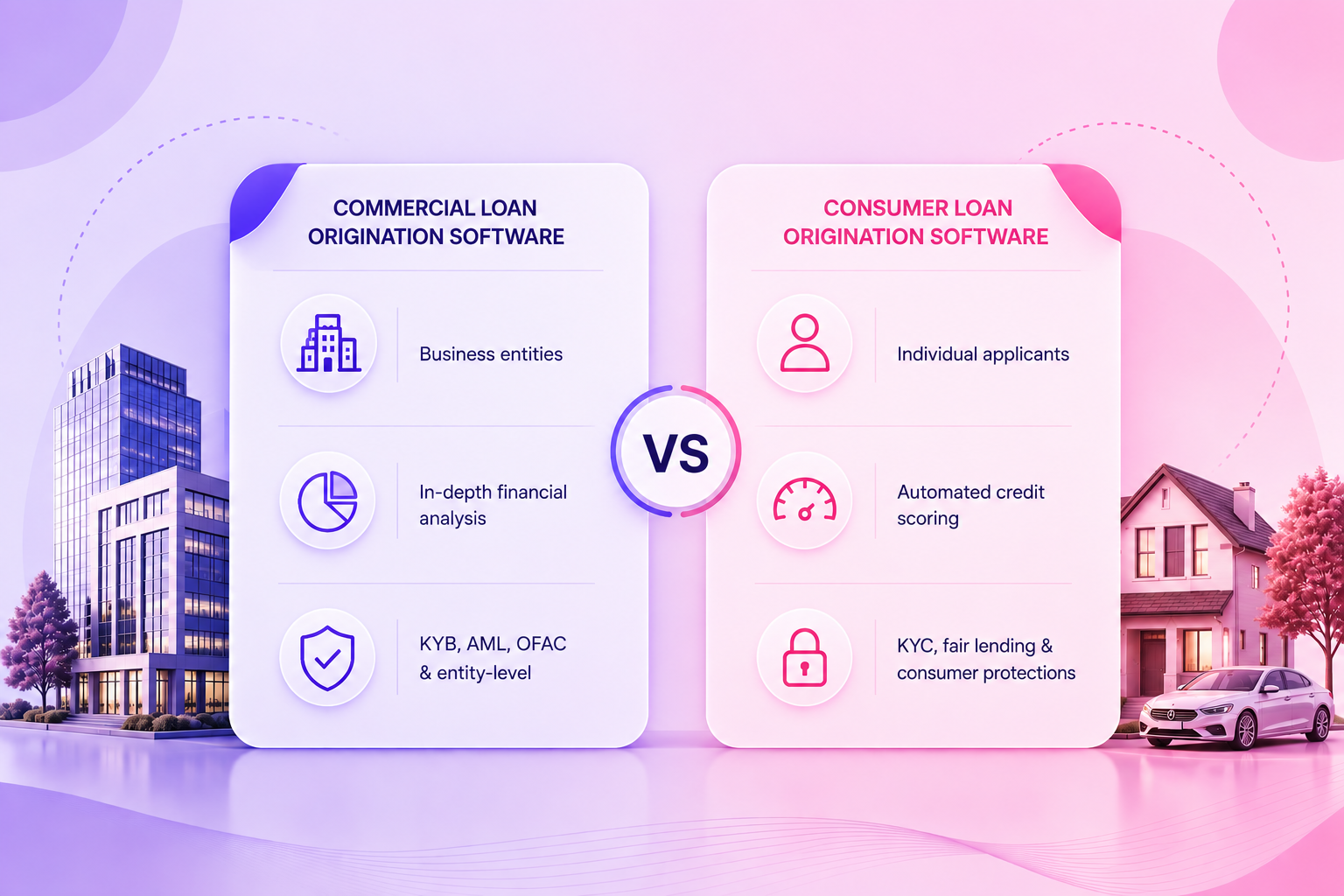
Commercial loan origination software and consumer loan origination software are designed for different types of customers; each using a different risk model or assessment and having diverse regulatory requirements. Understanding how these two differ from one another can help CDFIs, community banks, Fintech companies and equipment lessors choose an apt loan origination system.
The global commercial loan software market is estimated to be worth $19.84 billion in 2026 and is projected to grow to $41.66 billion by 2035, at a CAGR of 8.59 percent. This indicates that lenders are actively reevaluating their technology stacks right now, which makes this a useful time to clearly define the distinction between the two.
What Is Commercial Loan Origination Software?
Commercial loan origination software facilitates the entire process of issuing lending services for commercial entities, including applications, underwriting, and closing.
According to Gartner’s own Market Guide for Commercial Loan Origination Solutions, this is a type of platform that allows lenders to evaluate business creditworthiness using business applicant information, collect and analyze financial data, automate document processing, and support multi-party deal structures.
The category serves banks, community-based lenders, CDFIs, and equipment financing companies that underwrite corporate borrowers rather than individuals.
What Is Consumer Loan Origination Software?
Consumer loan origination software handles personal loans, auto loans, mortgages, and similar products where the borrower is an individual. Such systems are designed to handle high volumes of applications quickly.
They connect to consumers' personal credit bureaus, pull employment and income information, and run largely automated decisioning to move applicants from submission to approval within minutes.
Since most consumer borrowers apply individually as the primary applicant, only require their own credit file, and repayment terms are normally straightforward, managing this aspect of the customer relationship is much easier.
Commercial and Consumer Loan Origination Software Key Differences
Commercial Loan Origination Software Manages Complex Underwriting Requirements
Underwriting is where these two systems diverge in terms of visibility. Consumer loan decisions are typically based upon a credit score, a debt-to-income ratio and an income check.
Business loan decisions involve much more information such as reviewing financials, analyzing trends for cash flows over multiple years, comparing risks associated with the business's industry, and possibly evaluating the financial condition of multiple guarantors related to one transaction.
Commercial loan origination software requires user-configurable underwriting rules that can adjust according to loan size, industry type, and lender program instead of a single rigid scoring model. Those platforms that support only "pass" or "fail" logic force underwriters to move to spreadsheets the moment a deal gets complicated.
Data Sources and Credit Signals
Each system evaluates based upon what data they are pulling. Consumer platforms rely upon personal credit bureaus such as Experian, Equifax, and TransUnion, along with bank connectivity for income and identity verification.
On the other hand, a business' worth is determined by many more factors than just one credit score. So, commercial platforms need business credit data, Secretary of State registry checks, tax ID verification and lien or judgment records, etc.
Commercial Loan Origination Software that only provides integration with consumer bureaus causes underwriters to manually track business credit reports, UCC filings and bank statements outside of their system. The goal of automation is defeated by this process.
Collateral, Guarantors, and Deal Structure
A commercial loan generally has multiple layers of collateral like real estate, equipment, and receivables along with multiple guarantors for each facility. On the other hand, a consumer loan is generally simple and involves only one borrower, one lender, and at most one piece of collateral such as a vehicle.
Commercial loans can often include syndication or loan participation, which involves multiple investors funding a single loan and needing an automated way for their funds to be accurately tracked and reported on going forward. Most consumer loan origination platforms do not need to provide this function. Commercial lending platforms that do not have this functionality force lenders to manually manage syndicated loans in separate spreadsheets, and with larger portfolios, this creates opportunity for reconciliation discrepancies.
Compliance and Regulatory Requirements
There are significant differences in compliance requirements for consumer lending versus commercial lending. Consumer lending is regulated by borrower protection laws such as the Equal Credit Opportunity Act and fair lending disclosure rules, with primary focus on Know Your Customer checks.
Commercial lending includes KYB checks, entity level sanctions and OFAC checks, beneficial owner checks; and anti-money laundering obligations based on deal size.
Cloud-based deployment is rapidly becoming the best approach for keeping compliance workflow current. As per the forecasted data, over 68% of commercial lending software will be delivered from the cloud by 2035, primarily due to cloud delivery allowing regulatory updates that do not require lenders to apply on-site patches.
Deployment, Reporting, and Portfolio Visibility
Once the loan passes origination phase, reporting for both types of lending gets different. Consumer lenders report on their loans on an account-by-account basis.
- How much has been paid?
- How many payments are late?
- What is the current payment schedule?
Commercial lending reporting includes overall portfolio level analysis across assets, covenant tracking after disbursements, and investor reporting when a loan has been syndicated.
Currently North America represents approximately 37.5% of the global commercial loan software market which is largely due to lenders in this region focusing on platforms that connect origination data directly to servicing and reporting rather than treating each stage as a separate system.
Lenders Choose Commercial Loan Origination Software Based on Business Needs
Before investing in the platform, lenders need to look past the demo and see how well it can perform on a much more complex real-world scale. A few points worth checking before committing:
- Do you think the system can handle all different borrower entities and create specific credit scoring rules for each one? Or is it strictly just pass/fail?
- Is the system native to the integration of business credit bureaus, banks, and other public records?
- Are there capabilities to syndicate and report to investors if you choose to share any part of a deal with participating lenders in the future?
- Does compliance automation apply to both Know Your Business (KYB), Sanctions Screening and Anti Money Laundering (AML) at an Entity Level?
- Will all your origination data flow into servicing automatically when a loan closes and not require any manual entry?
Lenders who manage both commercial and consumer loan books need to consider if their origination systems are capable enough to handle both types of business, or if they require all deals to go through the same process. A system designed primarily to support simple, one-borrower consumer loans experiences problems when an account is processed as a multi-branch commercial deal with multiple layers of collateral.
The Cloud Maven, Inc's Loan Origination Software Platform is designed to meet the complexity of this process by allowing lenders to create their own underwriting rules, collect documents from applicants electronically, and have audit-ready workflows that adapt to business requirements. Those interested in seeing if there is a commercially viable solution available to address the complexity of the commercial loan origination process can schedule a demonstration.