When a borrower leaves a loan application partway through, most times the reason has nothing to do with how much you charge or who works for you. Most times it traces back to the loan origination software (LOS) that runs beneath them. That's the software that determines whether your borrowers find the process of getting onboarded easy or difficult.
So, selecting a vendor is a long-term operational decision lenders make when choosing their loan origination software. The LOS vendor you choose determines your ability to get loans approved quickly, your compliance, and your cost to fund for years to come.
The expectations of borrowers have rapidly changed in this area. Last year, Experian conducted a study of 708 senior credit and fraud risk managers across ten countries. Eighty-three percent stated that they believe real-time loan approvals should be the norm instead of being an exception.
However, achieving that goal relies less on a specific feature and more on selecting the right partner. This guide provides you with a practical way to evaluate and compare different loan origination software vendors.
Start by Defining What Your Loan Origination Software Must Do
Before the first pitch by a vendor, develop an internal brief for how your Loan Origination System should operate. This allows you to keep your assessment of vendors focused on your business operations as opposed to their roadmap.
There are three detailed questions to answer before you shortlist anyone:
- Where does your current process fail? Many common failures occur in areas such as manual intake, disconnected underwriting, and disclosures between origination and servicing.
- What type of loans do you handle? Each of consumer, commercial, and broker originated loans have differing requirements of the system.
- Where are you heading? Consider new products, new markets, and loan volume you expect to support two or three years into the future.
If your current system requires custom development to create a new product, delays approvals through manual transfers, or leaves gaps in your audit trail, these are all indications that modernizing your loan origination software needs to become a higher priority. An end-to-end lending suite allows your business to grow and expand rather than constrain it.
Core Criteria for Evaluating an LOS Vendor
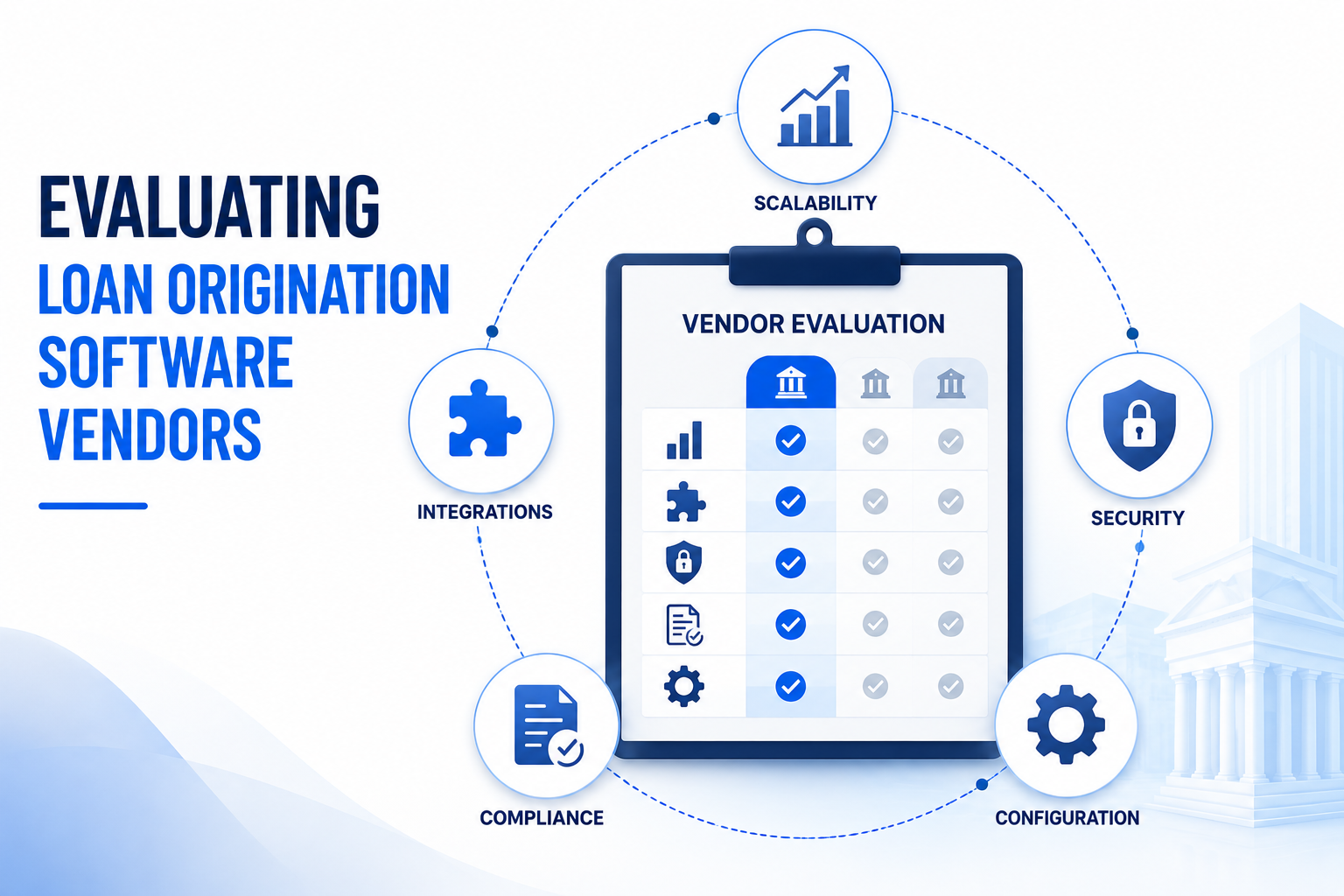
Once your requirements are defined, evaluate loan origination software vendors based on your documented criteria. In practice, three areas carry the most weight:
Scalability and Performance
Compare the platform to where you plan to be and not where you currently are. Ask if it can support several times your current loan volume along with the ability to make decisions in real time. With many risk managers anticipating instant approvals as the norm, a platform that cannot support this level of volume quickly becomes a competitive liability.
Integration and API Depth
Most modern loan origination systems are rarely used by itself. Data must flow back and forth in real time with multiple systems including but not limited to verification tools, credit bureaus, decisioning engines, servicing systems etc. An API-First Platform allows you to adapt to your current workflow rather than having your team work around its limits.
Configuration Over Customization
Customizing a product typically requires coding, which makes it more expensive, takes longer to develop, and creates a long-term obligation to maintain. Configuring products gives your team the ability to create rules, forms, and workflow changes through built-in tools, so you can launch new lending programs in days without a developer queue. A loan origination platform designed to configure also seems to last much longer than those requiring custom code for virtually all changes.
Compliance and Security Standards Every Loan Origination Software Should Meet
Lending sits among the most heavily regulated industries, and regulatory compliance burden continues to grow. Auditability and security belong to the core architecture of a loan origination system, not an afterthought.
The implications of this issue can be significant to many assessment teams. Approximately 43% of lenders indicate they have difficulty ensuring consistent audit trails across automated workflows. When evaluating potential vendors, ensure the platform includes the following:
- Automated audit trail with no opportunity to alter or delete by anyone within the organization
- Role-based access control and encryption included as default settings
- Regular third party security audits, recognized certification(s) from an industry association
- Transparency of disclosures at origination through service
A platform that actively prevents compliance gaps always serves you better than one that simply reports them once something has already gone wrong.
Commercial vs Consumer Loan Origination Software
The best vendor for you is the one that helps create your lending model, instead of having you fit into their model. There are many differences between consumer and commercial lending platforms, some examples include:
The strongest loan origination software configures cleanly for both models, which becomes a deciding factor when your portfolio spans more than one line of business.
Loan Origination Software Determines Total Cost of Ownership Across Build vs Buy Decisions
At some point, every lender evaluating a loan origination system faces a decision on whether they want to "build" or "buy". Both options have very real trade-offs that should be understood prior to making a commitment.
Regardless of where you decide to lean, do not focus solely on the pricing of system, but consider all aspects of total cost of ownership. Data migration, training, integration, and implementation typically cost much more than licensing fees.
Besides, legacy systems have hidden costs such as manual workarounds, expensive custom integrations, and increasing security gaps. A platform that connects origination directly to loan servicing also removes one of the most common and costly handoffs in the entire lending lifecycle.
How to Assess Loan Origination Software Vendors Beyond the Demo
A demo tells you how well a product works at its best. An assessment of a vendor tells you how well it will work with your organization during the course of the next five years. Roadmap has become especially important as the pace of lending technology accelerates.
According to a 2025 Celent survey of 106 US lenders, 67% have either already deployed or are planning to deploy generative AI in lending by 2026, with 83% increasing their budgets to support it. If you select a vendor with no appropriate long-term strategy, you may find yourself a step behind your competition.
Assess vendors based upon consistent criteria rather than relying on impressions from a sales call:
A great lending software provider acts as a partner and not simply as a supplier. They guide you through implementation, stay genuinely responsive afterward, and continue investing in the roadmap your future depends on.
Loan Origination Software Enables Salesforce-Native Lending Modernization at Scale
An effective vendor evaluation process points you toward a technology platform that can scale as needed by your company, is compliant when examined closely by regulatory bodies, and grows alongside your business. Cloud Maven, Inc delivers exactly that as a Salesforce-native loan origination system, which means a familiar interface, an implementation measured in weeks, and clean configuration across consumer, commercial, and broker-driven models without heavy code.
Lenders running on our platform have reported 53% fewer manual processes and 27% reduced origination costs, gains that come from automated intake, verification, and decisioning operating together in a single environment.
If you are weighing your options, a short conversation with us shows you how the approach maps to your lending operation.