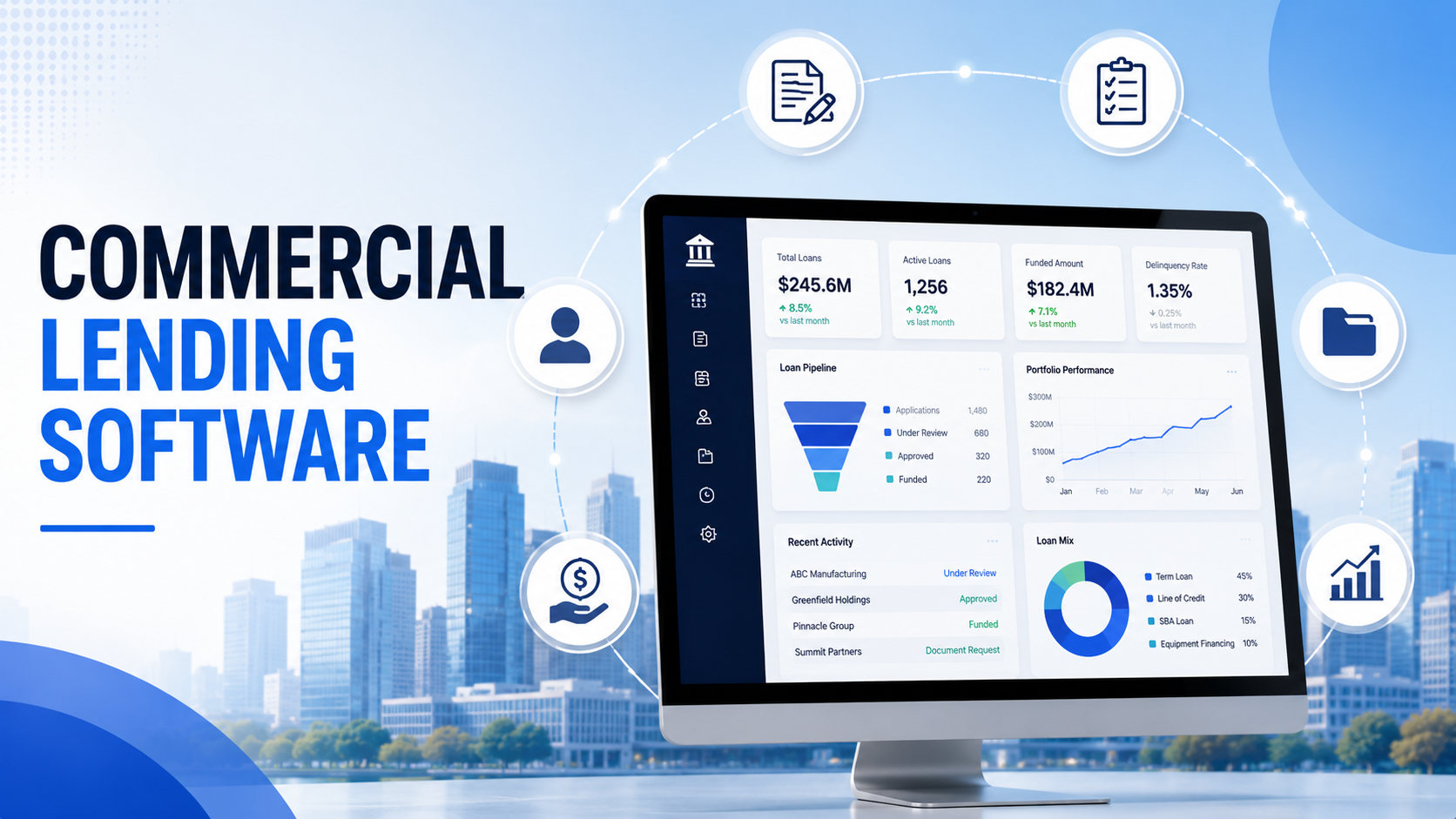
Commercial lending software is a platform that financial organizations use to manage all aspects of the commercial lending process, right from origination through to funding, servicing and ongoing portfolio management.
These platforms are used by banks, credit unions, Community Development Financial Institutions (CDFI), Fintech lenders, and equipment leasing companies to replace separate spreadsheet applications and email exchanges with a single connected platform.
For any lender weighing whether such a platform is worth the investment, ask yourself what impact it will have on how you currently conduct commercial lending, and why this will become the basis for differentiating from those who continue to do so manually.
What Is Commercial Lending Software?
Commercial lending software, sometimes called a commercial loan origination system (LOS), a commercial loan management platform, or simply a business lending platform, brings together each element of the commercial loan process in one single workflow.
A commercial loan can have many different components compared to a consumer loan which includes multiple financial statements, collateral requirements, covenant compliance, stakeholders approval and ongoing risk assessment that continues long after the money goes out the door.
Historically, lenders used spreadsheets, shared drives or disconnected point tools to connect the pieces of the commercial loan process. Platforms today integrate all aspects of the commercial loan such as the borrower's information, the credit evaluation, the approval process and post-closing monitoring.
Most software platforms organize their functionality into four connected pillars: Loan Origination, Loan Servicing, Syndication for multi-investor deals and Portfolio Visibility for reviewing performance of your entire loan portfolio. Understanding those pillars is the clearest way to see where the software earns its place.
Commercial Lending Software Helps Lenders Meet Modern Borrower Expectations
Borrower expectations have shifted faster than most lending operations have. For example, today a small business owner can open a checking account within a matter of minutes, So, when they experience a loan decision being made over the course of several weeks, this perceive your lending operation as weak or slow rather than a sign of diligence.
As such, it is clear why there is increasing competitive pressure on lenders to adopt new technology so that they can provide their clients with the type of fast service provided by the growing number of "digital-only" lenders.
That competitive pressure is also evident in how lenders allocate their capital. In 2024, the global commercial loan software market totaled approximately $7.6 billion and it is estimated to grow at an average annual growth rate of 9.7% per year through 2034. This indicates that while modernizing one's lending operations used to be discretionary, today it has become mandatory.
Conversely, the costs associated with maintaining manual systems are equally tangible. Industry study published in late 2025 revealed that loan origination typically takes fifteen to twenty days at many financial institutions. A significant portion of time spent in the underwriting process is wasted due to manually entering and verifying data.
Each of those delays is an opening for a borrower to abandon their application, for a lender to miss a regulatory requirement, or for a credit decision to deviate from institutional policies.
Commercial lending software matters because it narrows the gap between what borrowers now expect and what manual processes can realistically deliver.
Core Capabilities of Commercial Lending Software
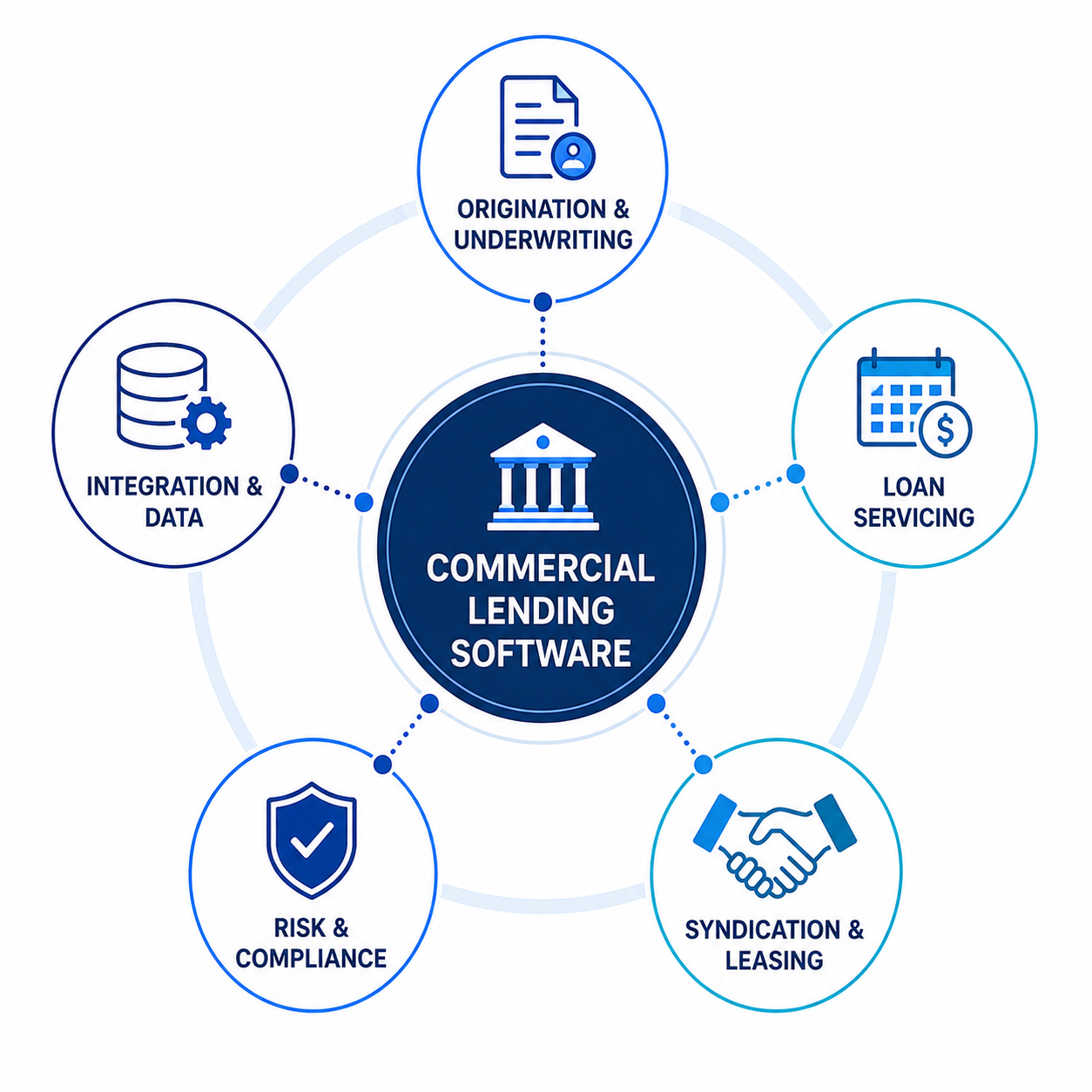
Lending platform capabilities can be quite different depending on who you are working with. However, most platforms will include many of the same features for every step of the lending life cycle. To better define what they do as a whole, the various components can be grouped into categories that include:
Commercial Loan Origination and Underwriting
Loan Origination includes application intake, document collection, credit analysis, and audit ready approval workflows. It carries a deal through all stages of origination and underwriting without having to re-key data at each stage.
Servicing
Loan Servicing includes payment schedules, escrows, fees, late payments, delinquencies, and borrower inquiries. All of this is done with real time access to how your portfolio is performing.
Syndications and Leasing
This category includes allocating deals across multiple investors, paying out money to investors based on deal allocation, and asset-backed workflows for equipment, vehicles etc.
Risk and Compliance
These areas include risk rating, monitoring covenants and exceptions, conducting KYC/KYB's, OFAC screening, and preparing reports that stand scrutiny from auditors or examiners.
Integration and Data
This category encompasses connections to credit bureaus, banks, e-signatures and back office systems. In essence data entered once is consistent everywhere it is used.
When viewed collectively, these categories represent a comprehensive process for managing lending rather than just a series of individual products. There is a significant distinction between product that truly accelerates lending versus product that simply puts a digital wrapper on existing practices.
Commercial Lending Software Outperforms Manual and Disconnected Tools
The clearest way to judge the value of commercial lending software is to set it against the spreadsheet-and-email approach that many teams still rely on today.
The pattern across every row points the same way. Manual methods trade short-term familiarity for long-term drag, while a connected platform compounds in value as lending volume grows.
Who Uses Commercial Lending Software and How to Make a Decision on Lending Platforms
Commercial lending software is used throughout an institution rather than a single team. Commercial lenders and loan officers use the system for managing the pipeline; credit analysts use it for handling risk ratings; portfolio and risk teams utilize the system for monitoring the books; and loan committees and leadership rely upon reporting to make and defend their decisions.
While selecting a commercial lending software solution, there are generally only a few key factors in deciding on a product:
- How well does it integrate with your core banking or existing systems?
- Does it have underwriting automation capabilities? Are credit rules configurable?
- What type of portfolio analytics can you perform and how often do you receive real time reporting?
- Is document management available and can borrowers access information through a secured portal?
- Can the product scale as your business grows, and does it provide hands-on implementation support?
A larger decision sits underneath those features, which is whether to assemble several point solutions or adopt one connected suite. A unified solution reduces integration costs and data inconsistencies that appear when a loan moves between multiple systems.
The operational benefits associated with a unified solution have been demonstrated by numerous studies. According to a 2025 market study, over 60 percent of respondents using commercial lending software experienced improved repayment collections. In addition, nearly 55 percent of respondents realized cost reductions due to automation.
This is where an all-in-one approach such as cmLending fits that bring origination, servicing, syndication, and lease management into a single Salesforce-native suite. Already used by more than 400 organizations, the platform allows lenders to keep borrower information, automations, communications, and compliance together in a single environment.
The platform connects to over 175 API's and 49 partner systems, allowing lenders to have their credit bureau pulls, bank information, ID/KYC/BKY verification processes, electronic signatures and payment processing run directly within their workflows.
A configurable Decision Rule Engine lets institutions set their own underwriting criteria around credit, income, collateral, and program eligibility, while AI-assisted document parsing and risk assessment reduce the manual effort behind each approval.
For CDFIs, community banks, fintechs, and equipment lessors, that combination supports faster decisions and clearer portfolio visibility without adding new systems or headcount as lending volume grows.
Where Commercial Lending Software Is Heading
The direction of the category is toward decisions that are both faster and better supported by data. With cloud deployments becoming the norm and AI transitioning from pilot project status to everyday underwriting, industry report shows that AI-driven document automation reduces loan processing time by up to 50%.
As for lenders, the real focus should be on selecting a platform that can handle each feature as they evolve. Lenders who choose platforms providing automated decision making along with configurable rules allow them to implement new technologies without having to rebuild their entire lending stack.
Commercial lending software has essentially become the operational layer for modern businesses lending, determining how fast a lender can say yes, how well they understand risk, and how far they scale without straining their team.
To see how a connected, Salesforce-native suite handles the full life cycle in one place, explore cmLending.