
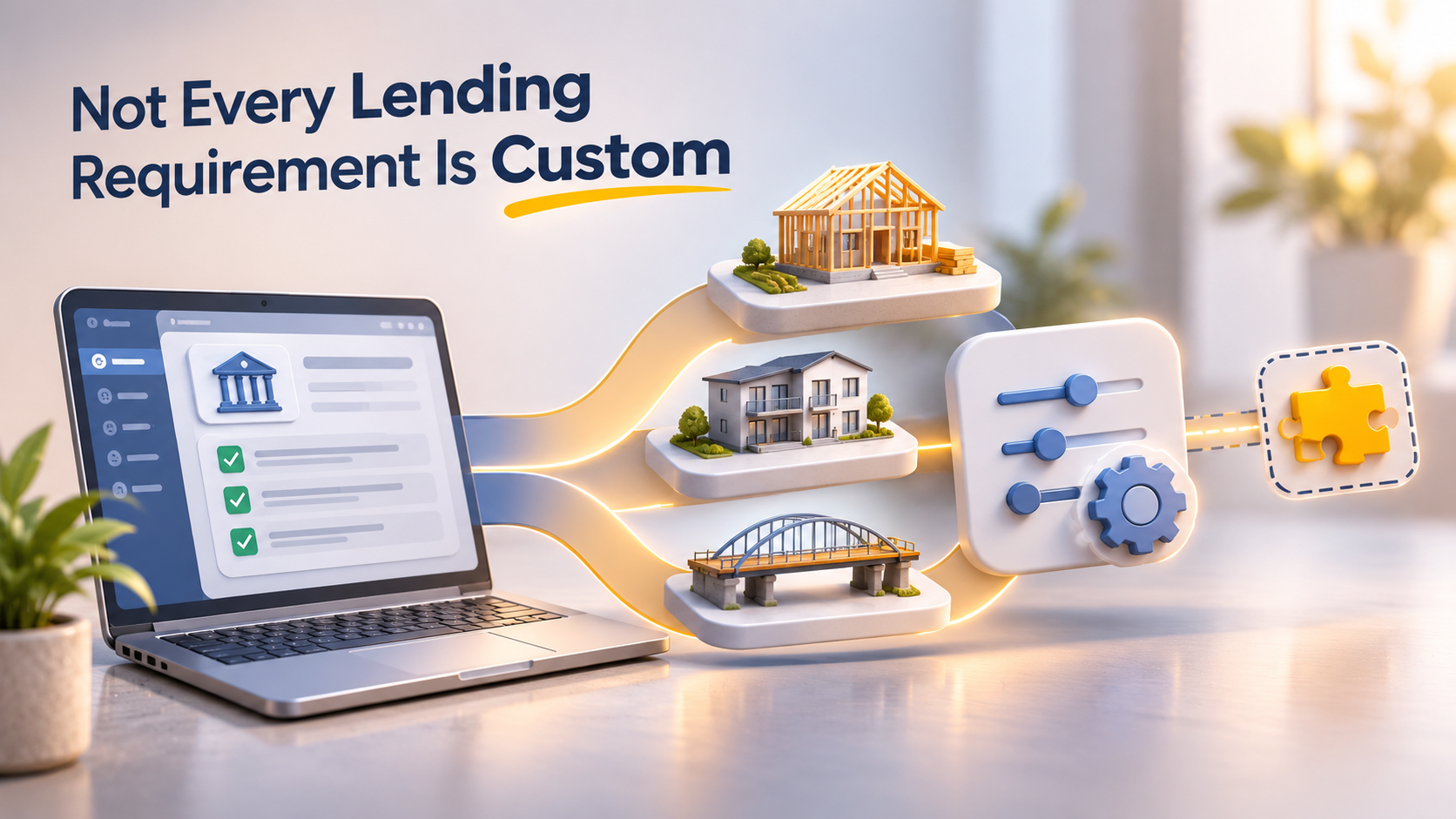
"Our lending model is little different!" This is how most lenders describe their business to a software vendor. Is that really the case with all? Most lending businesses have similar patterns across borrower intake, credit verification, document collection, approvals, funding, payment, etc.
Having said that, there are a couple of things that might be unique to a lending business like funding programs, interest payments, inspections, etc. These distinctions matter, but they necessarily don't make the whole operation exceptional. So be very careful when you define requirements for lending software since only a handful of your workflows need new development. This clarity gives software vendors something they can test, rather than just announcing your whole operations complicated.
If you’ve already noticed your team relying on workarounds because off-the-shelf loan software no longer fits your lending workflow, this is the next step: figuring out which parts of your process are genuinely different.
Where Lenders Overestimate Non-Standard Lending Requirements
Let's say you are a lender that offers short-term bridge loans as well as rental property financing. Now the bridge loan allows interest only payments or extensions, whereas on the other hand, rental loans follow a different amortization schedule. Since the approval and servicing differ for both products, it is highly likely that staff consider them separate businesses.
But both loan products require applicant records, payment terms, decisions, account histories and other similar details. So, what actually changes? Just the product settings and exceptions. The rest of the system doesn't have to change for each product.
Often times whenever a lender tries to launch a new loan product or change the existing one, they find the process to be unnecessarily difficult due to software in use. In Carleton's 2026 Platform Migration and Modernization Survey, you can see that nearly one in three lenders reported taking 6 months or more to implement a new product or regulatory change.
This raises an important point. What seems to be a complicated lending requirement is actually the limitation of the system they are using.
Sort Your Lending Workflow Requirements Into Three Buckets
Before you issue an RFP, look at each step of your lending process from application to repayment and give it a provisional label.
Just because a feature is listed on a vendor's website doesn't mean it will work for your lending process. Ask vendor to show You should know how the software works using your specific requirements, like the exceptions or any unusual scenarios your team deals with.
What Usually Belongs in the Configurable Bucket
You may want to think that your lending requirements are too complicated for standard software. In reality, the process is fairly simple. It's just that each lender has its own rules, and such differences can be handled easily through configuration.
Loan products and fee structures
Suppose you're a private lender offering nine-month bridge loans, twelve-month construction loans, and thirty-year rental loans. Each product has different loan amounts, payment terms, interest calculations, repayment schedules, and fees.
Instead of building a separate workflow for each product, a configurable platform can manage these differences through product-level settings.
With Cloud Maven, Inc's cmLending, lenders can manage different loan programs within Salesforce. cmLending is a loan management software built natively on Salesforce, so product terms, fee rules, underwriting criteria, approval routing, and funding program matching are configured rather than custom-coded.
Fees are another area where lenders often have different policies.
One lender might charge an origination fee at funding. Another might assess late fees after a certain number of days. Some lenders allow borrowers to pay an extension fee upfront, while others have specific rules for returned ACH payments.
Our loan servicing software supports fee calculations, payment applications, delinquency management, draws, payment returns, and transaction history.
Eligibility and underwriting rules
Credit teams usually describe their underwriting process as too specialized for standard loan software. Instead, document them as individual conditions that include credit history, cash flow, collateral, or exposure limits, and using set of rules, these can be easily evaluated.
Many lenders are still looking for an easier way to make credit decisions, especially when they have several underwriting rules, conditions, and exceptions to manage. In the 2026 Secured Finance Industry Technology Survey, you'll see that 63% of equipment-finance respondents needed the urgent technology improvement in credit decisioning and scoring.
With the Decision Rule Engine in cmLending, you can define criteria using credit, income, collateral, banking activity, lender programs, and your own business-specific conditions.
The rules can evaluate information across related Salesforce records, assign scores, and support automated decisions or manual review. For example, an application that meets standard lending criteria might move through an automated decision workflow, while one that falls outside defined thresholds can be routed for further review.
Approval routing and exception handling
You must see how the system handles approvals. Let's say, your branch manager is allowed to approve loans up to $75,000, but only the credit committee can approve a $750,000 loan. Then there are some types of collateral that need legal review even if the loan amount is small. You should be able to set up these rules in the software so applications go to the right people, tasks are assigned, and approvals are recorded.
cmLending supports configurable approval workflows, conditions, notifications, and task routing within Salesforce. Combined with the Decision Rule Engine, the platform can evaluate conditions and direct applications through the appropriate approval process.
Matching borrowers with funding programs
Say a borrower has a credit score of 610 who is asking $400,000 for a commercial property in New Jersey. Below are some of the programs:
- One program finances that state but accepts scores above 680 only.
- The second program requires more annual revenue.
- A third program asks for additional collateral.
The system should identify which is the eligible program and give reason why the other program(s) were excluded.
Our loan origination software supports lender matching based on credit scores, industry, revenue, loan amount, location, and risk level. It also gives you an explanation for each rule, which is useful for brokers working with multiple lenders.
This is particularly useful for brokers and lenders working with several funding partners, each with different eligibility criteria.
Rather than maintaining separate spreadsheets for every program, the matching rules can be managed within a connected lending workflow.
Servicing and investor participation
You should never stop testing the software at the funding stage. Go beyond closing as non-standard requirements continue. Before you assume that servicing software fits, define the payment allocation order, grace periods, draw treatment, extensions, ACH returns, payoff rules, and delinquency events.
It gets a little more complicated when several investors share the same loan. Say three investors each own a different portion of a loan. When the borrower makes a payment, the software should calculate how much each investor gets, handle any adjustments, and generate the right statement for each investor.
Cloud Maven, Inc's loan syndication software supports investor participation records, allocation calculations, distributions, ownership changes, and investor reporting. Because servicing and syndication operate within the connected cmLending environment, you can manage borrower payments alongside related investor allocations.
Identify the requirements for lending software that need new development
We completely agree that you may have some lending requirements needing extra development.
For example, you might calculate interest based on how the collateral is performing.
Or you have an agreement that defines the particular order in which the investors are to be paid.
You might also be using an older system that not at all works with the new software, or have situations when a payment is reversed, it needs updating records in lot of places.
These are situations where additional development or integration work may be necessary.
The important part is documenting what makes the requirement different. This gives you a clearer understanding of what can be handled through existing functionality, what needs configuration, and what genuinely requires custom development.
How to Present Loan Software Requirements to Vendors
Once you have categorized your requirements, prepare a list of few real loan scenarios and focus the discussion with vendor on important questions like:
- Standard functionality: Can the platform handle this scenario using existing features?
- Configuration: If it requires a rule or workflow change, what can be configured, and who can maintain it?
- Custom development: If additional development is necessary, what needs to be built, tested, and maintained?
- Exceptions: What happens when required information is missing, a payment is reversed, or someone overrides a decision?
- Cost and ownership: What additional implementation or ongoing maintenance costs would apply?
This approach helps you establish which requirements fit the platform before committing to a larger implementation.
For a more detailed comparison of vendor capabilities, demonstrations, integrations, and selection criteria, read our guide on How to Evaluate Loan Origination Software Vendors.
See How Cloud Maven, Inc Handles Your Non-Standard Lending Requirements
The most useful thing you can bring to a vendor conversation is a handful of real loan cases from your own business. Pick a few that tested your current process: an application that needed an exception during underwriting, a loan that had to be modified after funding, or a payment that didn’t follow the usual rules. Remove the borrower’s personal details, but keep enough to show what happened and how your team handled it.
Then ask each vendor to walk through those same cases in their software. Where something needs extra configuration or development, ask what’s involved, how long it takes, and what it costs. You’ll likely find that much of what felt “too unusual” is already handled, and you’ll have a clear picture of what truly needs to be built.
That’s the conversation Cloud Maven, Inc is built for. Bring your real loan cases to our team, and we’ll walk through how cmLending handles each one, including anything that falls into the bespoke bucket.
Schedule a walkthrough with Cloud Maven, Inc to get started.